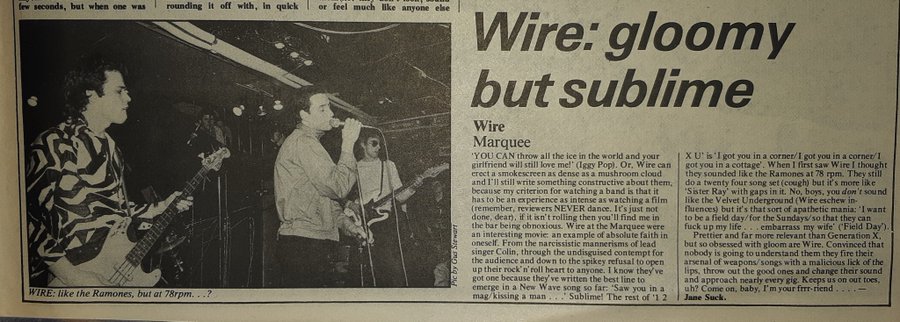
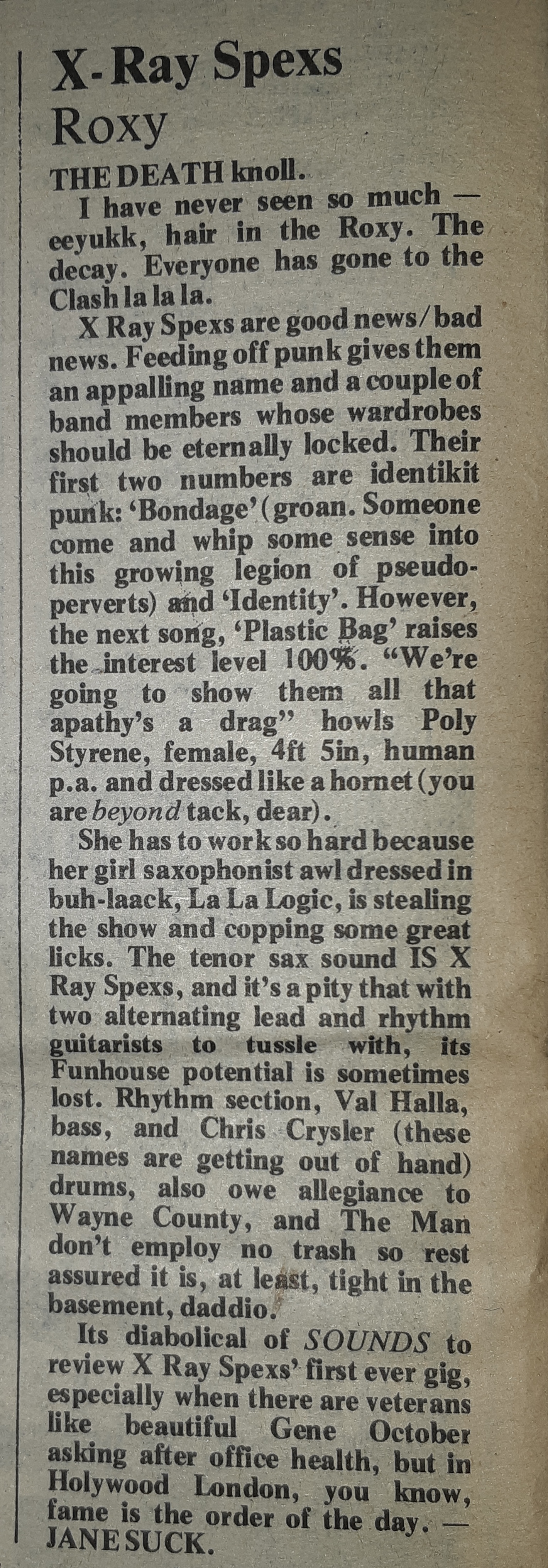
Sounds punk-era legend Jane Suck - who later wrote for NME as Jane Solanas, presumably an alias in homage to Valerie as in SCUM Manifesto - has died.
Here is Suck's intro / manifesto co-written with Jon Savage for Sounds's landmark New Musick feature package that started November 26 1977 and continued on December 3 1977.
And here is a piece she wrote as Solanas that is markedly different - a sympathetic take on Kate Bush at a time when the music press still largely scorned her as a kook with an overly dramatic / decorative and passe style of art-rock. ( Indeed even in the dek / standfirst, written no doubt by some male editor, they can't resist getting some digs in: "Kate Bush has moulded herself in an icon of pop erotica — so much that suburban couples claim her breasts stimulate their love making. Yet to like her voice and music is the ultimate in being uncool. Jane Solanas decides to give Kate the benefit of the doubt." )
Scans first, followed by the text
KATE BUSH profile
NME October 15th, 1983
by Jane Solanas
"Dear Kate
I love you. My brother is in the army and he's a git. I couldn't tell anyone else that. And no one else seems bothered about soldiers getting blown up young. I know you care. I just don't know you…"
"Dear Kate
Me and my wife watched you on the tele and we found your breasts stimulate our love-making…"
"Dear Kate
Your being Roman Catholic interests me…"
^^^^^^^^^^^^^^
There is the school of thought that Kate Bush is for mums and dads. Freakily lovable. The ET of pop — something to laugh at when females impersonate her on TV by donning explosions of brown wig, making stabbing actions with their hands, all the while wailing like a cat fight.
And there's a school who believe Kate Bush is "profoundly subversive", like Fred Vermorel.
Fred — more familiar to NME readers as Malcolm McLaren's old philosophical sparring partner, and co-author of a brilliant book, The Sex Pistols File — for some reason, freaked on Kate's nipples, which stuck out on the first EMI promotional poster, and went on to weave an almost demi-goddess identity for her, largely drawn from the rustic history of the Bush clan and Kate's turbulent schooldays. (EG: why did Kate never fight back when girls pulled her hair?)
But among a younger generation, the school of thought seems to be that liking Kate Bush is about as hip as owning a set of Melanie albums or else that she is… wonderful.
Someone at EMI said:" I 've yet to see anyone sum Kate Bush up."
Kate Bush said: "The thing I don't like about NME is it seems so cynical…"
Those are the two main problems.
^^^^^^^
It would be so easy to be horrible about Kate Bush. A hundred, even affectionate, jokes immediately come to mind.
The press tend to think Ms Bush is immune to satire, innuendo and downright rudeness. Somehow it's alright for Simon Bates to phone her up live on Radio 1 and bellow down the receiver about Kate's bank balance and sex life. The press can always say, "fuck you, you turgid cretin", but a household name is trained to be polite. It's a shame.
But on the other hand, Kate Bush is enigmatic, and what do you do when you don't understand someone? Either attack them ("Kate Bush is a spaced-out druid with lush tits…" is a familiar cry), or build fantasies around them a la Fred Vermorel.
I fell foul of the latter approach. I had so many preconceptions about the woman it was becoming painful. I expected her to be into horror movies, astrology, mysticism and sex, and based my questions around those subjects. I also expected her to have a sense of humour that would have me rolling in the aisles. I asked about the Kate Bush sense of humour at EMI and was told, yes, it existed but it was "off the wall". Unfortunately, it seemed to be out of the room when I was present, but then I shouldn't have expected a side-show.
I don't think the press would get Kate Bush so wrong, if she did not marry her music, which is strong enough already, to a controversial visual presentation. We've all got an instant picture of Kate Bush to draw on: "Oh yeah, she dances, don't she?" being another familiar cry. But think about it, how many dancing songwriters can you count on one hand?
Kate Bush has been somewhat dogged by her past, particularly in the light of the fact that she has been out of the public eye for over a year and her last major tour was as long ago as 1979. Hence impressions of Kate tend to be hopelessly outdated.
I never saw Kate Bush live, and had no interest in her work until the release of the 'Sat In Your Lap' single, so I asked EMI to show me some videos. I watched the Hammersmith gig from '79 and got a total shock: all Kate's songs which were finely imprinted on my brain were transformed into something straight out of Salem's Lot.
I got the impression that the 21-year-old Kate Bush was trying to be Peter Pan, but to me she came across as Varoomshka crossed with a vampire. It was genuinely frightening watching Kate stalking around the stage in various strange garb being man handled by two male/slave dancers, and pulling pained expressions with that extraordinary face of hers. Subtle it wasn't.
Four years on, Kate has calmed down a bit. I watched a preview of her Single File video; as might have been predicted, she is in her element on video. There's still quite a lot of frantic arm waving (and jeezus has she got a pair of arms!), but when she interprets her later material, she's easily one of the most entertaining musicians on film. The one's to look out for are: 'Army Dreamers' (see Kate get blown up), 'There Goes A Tenner' (see Kate blow a safe), 'Sat In Your Lap' (see men wearing goats' legs) and 'The Dreaming' (see God?).
Kate Bush hit her artistic peak on The Dreaming album. Yet sadly it wasn't recognised as an important or courageous album, and caused more confusion than fuss. The three singles taken from it, 'Sat In Your Lap', 'The Dreaming' and 'There Goes A Tenner', were her finest ever and sounded to me like sure-fire radio hits. But the Radio 1 DJs (except David Jensen) tittered nervously, and 'The Dreaming' just about did the whole station in.
She blew away that MOR' Wuthering Heights' image by changing her voice (lowering it) and injecting aggression into the music. There's a note on the bottom of The Dreaming album instructing you to play the record LOUD! Before, Kate Bush as a flaming great noise would never have occurred to anyone.
Kate Bush has always been a unique talent on the music scene. Her individuality and imagination are unusual in an industry which constantly makes do without either. As a songwriter she has the ability to take intriguing subject matter — yes, Wuthering Heights, Houdini, Henry James' The Turn Of The Screw, aspects of war, anything from aborigines getting mowed down by trucks to soft porn — and condensing it into song.
She wrote one of the best anti-army songs ever ('Army Dreamers'); and, of course, she has that voice, distinctive and constantly changing.
Her attitude to work is interesting. It's well known that the EMI machine has been good to her, allowing an extraordinary freedom in the running of her career. But there is still the pressure to promote herself and she has wilfully taken a back-seat. She spent so much time working on The Dreaming, she knackered herself and scrapped plans to tour. She is currently working on new material, but this is still only at the demo stage, and how long she will spend in the studio throwing her voice of walls is anyone's guess.
She is reluctant to do press because of bad experiences. She seems obsessed with doing things right, be it a performance or a photograph, and she does not seem afraid to wait. I find that a rare quality.
^^^^^^^^^^^
The interview I did with Kate Bush for two hours in a dance studio in South London was marred by the preconceptions I mentioned earlier.
I've got only one clear impression of Kate Bush's personality: she's sweet. She wouldn't stomp on a spider if it was three inches wide and crawling through her hair; she wouldn't shout at anyone no matter how obnoxious they were being. I got the feeling that all the energy other 25 year olds might expend on being sassy, sexy and a minor hell-raiser in order to impress their personality on the world, for her is contained and released in her work.
This is not to say Kate Bush outside of a studio or off a stage is vacuous or innocent, but she is unusually quiet. I saw no trace of the extrovert that comes across in her music: I don't think I gave her enough scope to talk about the things, chiefly her songwriting and her dancing, that she would have liked to.
A lot of the time was spent patiently explaining no, she wasn't into this or that, or no, that was an interesting way of looking at it, but not her way. As a "fan", I was probably cute. As an interviewer, a load of crap.
For example, I liked the way she handled this question:
Fred Vermorel wrote a curious thing about your lacking aggressive emotions. Yet The Dreaming seemed to work because it sounded so aggressive. Can you comment on that?
"I think the last album is about trying to cope… to get through all the shit. I think it was positive, showing how certain people approach all these negative things (war, crime etc). I don't think I'm actually an aggressive person. I think I can be… but I release that energy in work. I think it's wrong to get angry. If people get angry, it kind of freaks everybody out and they can't concentrate on what they're doing."
I thought that was an admirable piece of logic. I wasn't so keen on Kate's surprised dismissal of my question on her sexual identity as a female performer:
I once saw a photograph of you taken from your live tour and you were covered in sweat and licking the barrel of a gun. I found it erotic but frightening, because it was so blatant. (I also accused her, after watching the video of the Hammersmith gig of oozing sex all over the stage.) What, as a performer, are your feelings with regard to an audience's erotic reaction to you?
"I suppose it's something I don't really know about. Your energy on stage dictates the character you are (then). I'm too subjective. I just see me… either I get embarrassed or it's working."
It seemed to be news to Kate that her visual presence might have a dramatic sexual effect on people. I closed that part of the conversation with a muttered, "Well, it must be my filthy mind (chortle)". But later I remembered all the comments I'd heard when I'd told people I was going to meet Kate Bush: "tits" and "naked photographs" being uppermost.
Also, in a later question about her initial press identity, Kate remarked, "When I first appeared the press couldn't handle me in any normal way. I was the girl who sang in a funny voice with — 'The Body'…"
There is a video on the Video File that shows "The Body" to wonderful effect. As you can imagine, I buried the next question, Do you think women get off on you?, in fine flippant style. But I liked her candidness in other areas.
Do you like books?
"Yes. But I'm a really slow reader. Every time I read a good book it's in my head for weeks… like The Shining (Stephen King), that went straight into a song."
We had already established that Kate was a keen film fan when I asked this one:
Do you like gory things or taboo subjects?
"Some taboo subjects definitely attract me… I don't think I do like particularly gory things. Like, Don't Look Now, Psycho (films Kate likes), its not the gore so much as the emotional effect — the distortion. I don't think I'd ever go and see Texas Chainsaw Massacre and Friday The 13th, things like that. It think it's sick. You KNOW everybody is going to die disgustingly. I prefer films that work around the subject, build you up…"
Did you ever go through the hippie stage?
"No. I was just a few years too young. In some ways my attitudes could be associated with the time. I mean, I was growing up in the '60s…" (EG: Kate is well gone on The Beatles).
Were you ever into teenage (fashion) cults. Like a skinhead (titter) or something?
"No. I don't think I ever felt I could be convincing enough in any of the roles."
Do you ever get drunk?
"I don't really like alcohol. It doesn't get on with my body… (But) I've got a strong stomach. I can eat a lot… a great combination of things."
Well, I think it's far more interesting to know that Kate Bush is a gut than that Lena Zavaroni is a Freudian anorexic.
^^^^^^^^^^^^^^
You wouldn't believe how physically small Kate Bush is. After the interview, I looked down at her and, for a split second, I wondered how she'd ever make it across the street, let alone be someone people would like to touch, annoy, know. She lacks the cynicism and mistrust of the '80s, yet she's got a single-mindedness that transgresses all the pitfalls of fashion and falling sales. We should stop bugging her.
^^^^^^^^^^^^^^^^^^^^^^^^^
And here is Solanas reviewing a book by her erstwhile hero / ally / role model (?) Julie Burchill

^^^^^^^^^^^^^^^^^^
More Jane Suck through the auspices of Sounds Clips