Showing posts with label NME 1983. Show all posts

Saturday, October 12, 2024

Lester Bangs on Miles Davis (originally published Phonograph Record, June 1976; republished NME, April 30 1983)

Continuing the series of critics missing the significance of a record on its initial release - here is Lester Bangs in 1976 with what is ostensibly a review of Agharta but is really a panoramic takedown of Miles Davis after In A Silent Way. It's included here mainly for its utterly wrongheaded take on On The Corner and similarly dismissive reaction to Get Up With It

Originally published in Phonograph Record in June 1976, the piece was reprinted in NME in 1983 as a tribute following Bangs's death and that's what is reproduced here (to read it in full you might need to download the images - but there is a portion of it in text form below). 

By the end of the 1970s Bangs completely changed his tune and decided that On The Corner was genius and in some piece or other (corralled in Psychotic Reactions) declared that he would stake his writing life on Get Up With It and Metal Box

Nowadays you will get lists that place On the Corner as #1 Miles album.


".... But here I sit, nearly three years later, and this man and his music refuse to ease their stranglehold on my tastes, more, my emotions. I am obsessed with him because he once released Sketches of Spain, which contains an adagio passage in Rodrigo’s ‘Concierto De Aranjuen’ which may hold more distilled sorrow than any other single solo by anyone I have ever heard; I am obsessed with him because Kind of Blue, like Birth of the Cool a decade previous, defined an era and produced some of the most beautiful, spacious, expansively inspired music it was to know; I’m obsessed because In a Silent Way came close to changing my life, reinstalling a respect for the truly spiritual aspects of music when I was otherwise intent on wallowing in grits and metal; I’m obsessed, simply because he is Miles, one of the greatest musicians who ever lived, and when a giant gets cancer of the soul you have to weep or at least ask for a medical inquiry.

Which is why I have been studying Miles’ work for the past year or so, trying to figure out where (if?) he went wrong. Think about the fact that this guy has been making “jazz” records since the late Forties, and that many of them, way more than any single musician’s share, have become (to borrow the title of one) milestones. The man has defined at least three eras in American music – can Dylan say the same? Never mind that when In a Silent Way came out it had the same effect as Charlie Parker’s renaissance and influence on his followers – i.e., it ruined a whole generation of musicians who were so swept by its brilliant departure that they could do nothing but slavishly imitate so every goddamn album you heard dribbled the same watered-down-kitsch-copy of Miles’ electric cathedral – it remains that now, seven years later. In a Silent Way not only has not dated but stands with Sketches of Spain and a few other Miles albums as one of the sonic monuments of our time. And that’s neither hype nor hyperbole.

But since then, the years, private problems, celebrityhood, hipper-than-thous – something, whatever, has taken its toll. On the Corner was garbage. So was, with the possible exception of one bit I have been told about but am unable to find in its four unbounded 30-minute sides, Miles Davis in Concert, Big Fun and Get Up with It were largely left-overs, with predictably erratic results. The former’s “Go Ahead John” was a cooker, but too much of the rest was something never previously expected of Miles, simple ideas repeated for whole sides, up to a half hour each, in an electronicized receptiveness and distortion-for-its-own-sake that may have been intended as hypnotic but ended up merely static. What was perhaps even more disturbing was that once you got past the predictability and disappointment and analyzed the actual content of the music, it took Miles past his traditional (and traditionally heart-wrenching) penchant for sustained moods of deep sadness into a new area redolent more of a by turns muzzy and metallic unhappiness. He should have called one of these albums Kind of Grim. And mere unhappiness, elaborated at whatever electro-technocratic prolixity, is not nearly the same as anguish.

Much of Miles’ finest music, from Blue Moods to “Prayer” on Porgy and Bess to Sketches to My Funny Valentine, has been about inner pain translated into a deep mourning poetry so intense and distilled that there have been times when I (and others have reported similar reactions) have been almost literally unable to take it. I have always been offended when people ask me to take off any jazz record because they find it “depressing,” but secretly I always knew what they meant. Because there were times when I found Miles’ anguish not purgative but depressing, when I had to yank Jack Johnson out of the 8-track deck because I could not drive to the laundromat with such a weight on my heart; but I also knew the reason why I (and, if I may be presumptuous, the nebulous anti-jazz people I just mentioned) was depressed: because at that moment there was something wrong with me, of a severity that could reach by degrees from my consciousness to my heart to my soul; because I was sweeping some deep latent anguish under the emotional carpet, or not confronting myself on some primal level – and Miles cut through to that level. His music was that powerful: it exposed me to myself, to my own falsity, to my own cowardice in the face of dread of staved-off pain. Because make no mistake, Miles understands pain – and he will pry it out of your soul’s very core when he hits his supreme note and you happen, coincidentally, to be a bit of an open emotional wound at that moment yourself. It is this gift for open-heart surgery that makes him the supreme artist that he is. So, obviously, I am damned if I am going to shrug him off at this point. I am going to tear these fucking records apart and find out what the source of the cancer running through them is, praying for cure....."

He's not wrong about the soul-sickness in Miles's music of the 1970s... but for the life of me I can't see why he didn't recognise that this made this music compelling, a puzzle worth solving. 

^^^^^^^^^


Here as a chaser is Bangs getting it right in real time:  a rhapsody about In A Silent Way for Rolling Stone. 

Miles Davis
In A Silent Way
by Lester Bangs


This is the kind of album that gives you faith in the future of music. It is not rock and roll, but it’s nothing stereotyped as jazz either. All at once, it owes almost as much to the techniques developed by rock improvisors in the last four years as to Davis’ jazz background. It is part of a transcendental new music which flushes categories away and, while using musical devices from all styles and cultures, is defined mainly by its deep emotion and unaffected originality.

Miles has always gone his own way, a musician of strength and dignity who has never made the compromise (so poisonous to jazz now) with “pop” fads. It is a testimony to his authenticity that he has never worried about setting styles either, but continued his deeply felt experiment for two decades now. Albums like Miles Ahead, Kind of Blue and Sketches of Spain simply do not get old, and contain some of the most moving experiences that any music has to offer. In his new album, the best he has made in some time, he turns to “space music” and a reverent, timeless realm of pure song, the kind of music which comes along ever so often and stops us momentarily, making us think that this perhaps is the core around which all of our wayward musical highways have revolved, the primal yet futuristic and totally uncontrived sound which gives the deepest, most lasting sustenance to our souls, the living contemporary definition of great art.

The songs are long jams with a minimum of preplanned structure. That they are so cohesive and sustained is a testament to the experience and sensitivity of the musicians involved. Miles’ lines are like shots of distilled passion, the kind of evocative, liberating riffs that decades of strivers build their styles on. Aside from Charles Mingus, there is no other musician alive today who communicates such a yearning, controlled intensity, the transformation of life’s inchoate passions and tensions into aural adventures that find a permanent place in your consciousness and influence your basic definitions of music. And his sidemen also rise to the occasion, most of them playing better than I have ever heard them before. Certainly Herbie Hancock (piano), Wayne Shorter (tenor sax), and Joe Zawinul (organ) have never seemed so transported. The miracle of jazz is that a great leader can bring merely competent musicians to incredible heights of inspiration —; Mingus has always been famous for this, and Miles has increasingly proven himself a master of this incredibly delicate art.

The first side is taken up by a long jam called “Shhh/Peaceful.” Tony Williams’ cymbal-and-brush work and the subtle arabesques of Zawinul’s organ set a space trip, a mood of suspended time and infinite interior vistas. But when Miles enters, the humanity and tenderness of his trumpet’s soft cries are enough to bring you tears. I’ve heard that when he was making this album, Miles had been listening to Jimi Hendrix and Sly and the Family Stone, but the feeling here is closer to something like “2000 Light Years From Home” by the Stones. It is space music, but with an overwhelmingly human component that makes it much more moving and enduring than most of its rock counterparts.

Side two opens and closes with the best song on the album, a timeless trumpet prayer called “In a Silent Way.” There has always been something eternal and pure in Miles’ music, and this piece captures that quality as well as anything he’s ever recorded. If, as I believe, Miles is an artist for the ages, then this piece will be among those that stand through those vast tracks of time to remind future generations of the oneness of human experience.

Between the two takes of “Silent Way” lies “It’s About That Time,” a terse, restrained space jam somewhat reminiscent of the one on the first side but a bit sharper, allowing more of Miles’ fierce blues ethos to burn through. This is the one that might be connected to Miles’ interest in Hendrix and Sly.

They say that jazz has become menopausal, and there is much truth in the statement. Rock too seems to have suffered under a numbing plethora of standardized Sounds. But I believe there is a new music in the air, a total art which knows no boundaries or categories, a new school run by geniuses indifferent to fashion. And I also believe that the ineluctable power and honesty of their music shall prevail. Miles Davis is one of those geniuses.


^^^^^^^^^

Not one of his great reviews - often in praise mode he over-relies on these windy vague terms, a rather standard lexicon of humanist-literary approbation. “Timeless”, “heights of inspiration”, “the oneness of human experience”. Almost a sense of being intimidated by the subject.

^^^^^^^^^^^

And here's me with the benefit of hindsight - but well before it became a fashionable opinion - bigging up OTC. August 17 1991, Melody Maker


Some windy, lofty lingo in there - and below too.

From a few years earlier - September 2 1989 - a paean to Silent Way. 


Saturday, March 9, 2024

Barney Hoskyns - Barry Manilow - NME - September 10 1983


One reason I get a little impatient with the "now we make amends for the crimes of rockism" type work that's been going on this past decade or so, particularly in America  - writers and publications virtuously  giving attention to genres of music formerly neglected and demeaned - is that I grew up on a publication that did this kind of thing back in the early '80s.  All these moves of taking teenybopper pop seriously, arguing the case for the manufactured and the slick....   it wasn't quite routine, but it was normal. Of course there's great things coming out the pop assembly line.... of course the M.O.R. and the A.O.R. can contain moments of piercing genius.... of course there's no area that you a priori rule out of contention or attention. 

Case in point, this great report by Barney Hoskyns - who typically raved about everything from The Birthday Party and The Fall to Carol Jiani and the S.O.S. Band - but here writes sympathetically about the huge cult adoration of  Barry Manilow, as manifested at a mega-concert at Blenheim Palace.  

This story appeared on the news pages of NME -  you opened the paper that week and this was the first thing you saw,  nestling amid items on forthcoming albums and tour announcements.  The UK weekly music papers (and this goes back to the 1970s and earlier, as I found when reading Melody Maker et al for the glam rock book) covered everything that was newsworthy and, in terms of reviews and interviews, did a sweep across the entire spectrum of popular music (and quite a lot of unpopular music too). Comprehensiveness was baked-in, taken for granted, axiomatic, virtually automatic. Simply the job that was there to be done. 

(This actually carried on into the late '80s and early '90s, despite the increasing specialization in the music media and fragmentation of the music scene... in defiance of entropy, a keeping faith with the original conception of what a weekly music paper should be doing) 


Saturday, February 24, 2024

Charles Shaar Murray - Ohio Players (live in 1975) - NME - December 24 1983


This review made an impression when I read it in the Christmas 1983 issue of NME. The concept of this page "The Ghost of Live Past" is reviews not of concerts from the preceding week but from years ago - writers revisiting  gigs that had a profound impact on them. 

In this case, NME legend Charles Shaar Murray remembers a 1975 concert by Ohio Players he saw in Detroit. The first part of it is simply a well-observed live review (I should imagine that unless he has phenomenal powers of recall, CSM had been there to do a feature on the band and consequently had some old notes that he could draw on). 

Where it gets interesting is when he gets into meta-talk about how black music works for its audience - an Ohio Players performance as the performing of a community service, the sound and the stage show  communicating with the band's primary fans on a vibrational level that necessarily bypasses even the most informed and sensitive white listener.  

Earlier in the 1970s, CSM did a round-up review of a bunch of soul and R&B records, criticizing some (Isaac Hayes for instance) in a fairly standard for the time white rock critic way: too slick, too over-produced / too over-arranged, too close to showbiz.  As a fan of blues (later to write books about John Lee Hooker and Jimi Hendrix), he would have had that preference for the gritty, the raw, the raspy - and an antipathy for the mellifluous and the polished. Here, though, just a few years later,  he grasps the power of slickness and tightness, the sheer commitment to entertainment manifested by Ohio Players. 


There's a phrase in this review - "their murderous and militant elegance" - that I assimilated so deeply I must have come to believe I'd thought it up all by myself, reusing it sometimes almost word for word and other times in adapted form (e.g. "lethal panache") many times over the years.

A few years later, I would have a similar revelatory experience to Charlie Murray's when I went to review Zapp for Melody Maker. A show so militantly - no, militarily - tight and professional I went to see the band perform it again at the same venue the very next night. 


Wednesday, January 3, 2024

Julie versus punk(s)

Julie Burchill had loudly left the NME for greener pastures by around 1981 - but she could be coaxed back for the occasional assassination. 

Here, in a single issue, May 28 1993 - and in fact, as printed, on a single page - she sticks the shiv into two punky old fools she must have rubbed shoulders with down the Roxy many a time: Malcolm McLaren and Siouxsie Sioux

Although for a long while a grieving punk epigone herself, insisting that nothing could ever compare to Sex Pistols, by around '83 JB had moved firmly into the acceptance stage of mourning and espoused the view that a properly adult usage of pop would be as an aural after-dinner mint, things like Sade that served as background sounds for grown-up conversation, or sex.  


(via NME 1980s)


Thursday, January 26, 2023

Julian Cope - Tales from the Drug Attic - NME - December 3, 1983


Tales from the Drug Attic - Julian Cope's legendary paean to 1960s garage bands / punkadelia / psych)


published in NME, December 3, 1983


"The Dog-star rages! Nay 'tis past a doubt, All Bedlam, or Parnassus, is let out." - Alexander Pope


When I tell you about psychedelia, you can forget all the Peace-Love-Dove shit. You can forget about all the hippies you ever hated. You can forget about the understanding and the answer. Cast your mind back to the question.


Cast you mind back 5-10-20 years to the first time you ever thought about sex. When a penis, a vagina, were new words in a book.


They fit together, you say? One gets hard and one gets soft? That's repulsive, I'm going to be sick. Never think about it. Do my parents do it? Why did they invent it? Will I ever do it? Why did they invent it? I hate everything.


Your first psychedelic experience. The ship goes down with all your sanity.


So here we are - Psychedelia, when the question gets bigger and bigger, and the answer fades out obsolete.


Forget Timothy Leary and forget about the Tom Wolfe stories. When LSD hit the world, the intellectuals thought about it and the rest freaked out. 


It's the rest we're interested in. 


It's the rest who made the music. Not The Grateful Dead, not Quicksilver Messenger Service, not the Moody Blues. The ones we should be interested in are the 17-year-old kids from Birmingham to Albuquerque who took acid and tried to play old Van Morrison/Stones riffs. Suddenly they were something very new. True they couldn't play very well and the singer didn't know the words, but we all mean it don't we? So we could be bigger than anyone.


"Look out, I'm gonna get my seven Cadillacs, And maybe I'll drive around the World" - The Silver Fleet


^^^^^^^^^^^


The singer in every great psychedelic group was 5' 10". He stooped because his friends were small and he felt like a spaz. He sung about being himself, his ideal self, which was really Mick Jagger.


His real life was a dry-wank.


This is psychedelia.


Garage-music overproduced in four track studios. Musicians who wanted to be so famous. fuck, I'd sell out if I know how to! People who were too nihilistic to ever get it together.


Say yes to - Ed Cobb, Sky Saxon, Syd Barrett, Roky Erickson, Eddie Phillips, Arthur Lee, Moulty, Mouse, Dave Aguilar, and all the others who never could.


In their hunchbacked Twilight Zone, they made the best, most formidable sound ever. Rock powered emotion in all kinds of music. Arthur Lee? you say. Wimp music! Sky Saxon? A spoilt rat-faced child!


Then fuck you I say. Fuck your lack of compassion, your world concern, and for forgetting the individual, the small want-to-be-big individual who tore out great handfuls of his soul for a promise of a no-meaning 15 minutes of fame.


I love them. I love their misery. I see their parallels strewn out in front of me: Patti Smith, with baby, in some Midwest Hicksville, thinking she is at peace. Marc Almond hysterical and praying for fame with an on-off switch. John Cale's waking dream of one daytime radio play. Peter Hammill seeing his reflection in Mega-Bowie, Mega-Gabriel, Mega-Marillion. They are many. And I love them too.


So forget the Hippy.


We're talking of pre-Hippy, when even the quietest music had an intent that could not be ruffled.


A three chord riff, delicate voice and; "Oh, the snot has caked against my pants," - Arthur Lee 1967


This is psychedelia. One album, almost alone, inspired new love and attitude to the music.


"I just hope you have as much fun letting it spin as I did putting it together." - Lenny Kaye, on 'Nuggets', 1972.


For the time being, I shall presume that everyone has a copy of 'Nuggets'. If you know nothing else about psychedelia, you should know this. If not, put the paper down and go and listen to all the basics: The first Pink Floyd, 'Revolver', Traffic, The 13th Floor Elevators, 'Sgt. Pepper', 'A Web of Sound', 'Forever Changes', etc.


'Nuggets' was and still is the basic introduction. It gave us groups that were then so obscure but now, to a mass of people, are favourite listening. It introduced us to The Seeds, Chocolate Watchband, Elevators, Remains, Standells, Electric Prunes and so many others who had classic but unknown songs released. By now we know that had also recorded classic LP's. 


But during the '70's, these LP's were sold next to garbage like Strawberry Alarm Clock, Josephus, Blue Cheer, Bubble Puppy, anything on International Artists. You had to listen to all the I.A. catalogue to find out that the only things necessary were the 13th Floor Elevators LP's.


Psychedelia was being sold as hippy music by charlatans who thought any journey-thru-my-inner-mind-man nonsense was hip.


But the influence of 'Nuggets' was deep-rooted. This supposed 2nd Division music was the real psychedelia.


"Between thought and expression lies a lifetime" - Lou Reed


SO HERE we are in 1967. The Beatles have already previewed what's going to happen with 'Revolver'. The Rolling Stones are about to give psychedelia a bad name with a piece of 90% trash called 'Their Satanic Majesties Request'. The Yardbirds are featured in Blow-Up, a far-out forerunner of Zabriskie Point where Jeff Beck destroys his guitar during 'Train Kept A Rollin'.


In the US the vanguard was being led by Grace Slick, Jerry Garcia, John Cipollina and more mid-twenties graduates intent on rationalising the scene. The Doors had signed to Elektra, successfully promoting previous Elektra biggie Arthur Lee into Total Paranoiac.


And then came the group who drew the line between the hippies and the rest.


They were The Mothers of Invention. They had been signed as a blues band by an acid raving A&R man who committed suicide by self-immolation when the bill for their first masterpiece, 'Freak Out', came to over $20,000. The Mothers were unsafe and unsanitary; unhealthy leaders of the real underground.


Frank Zappa was shrewd enough (and old enough) to laugh at the very scene which bought his records. His songs were anything but the anthems-of-togetherness adored in Haight Ashbury. They were vile attacks on both straights and weirdos. Songs like 'Plastic People', 'Flower Punk' and 'Trouble Every Day' were vicious. Yes, you could laugh, but how did we know he wasn't laughing at you?


The Mothers sound even influenced the suburban punk groups. Teddy and His Patches, from San Jose, did a mind-blowing cover of 'Suzy Creamcheese', available on 'Pebbles III'. Psychedelia Piss-takes continued with 'I'm Allergic To Flowers' by Jefferson Handkerchief. The punks were becoming yippies, long haired peace-haters. It even swept to Britain with the Mothers-influenced Deviants.


In 1967, Frank Zappa produced 'Loose Lip Sync Ship', an instrumental 45 by The Hogs. The Hogs were really The Chocolate Watchband, a collage of musicians like by Ed Cobb, writer of 'Tainted Love' and producer of millions. Until 'Nuggets', The Chocolate Watchband were unrecognised. Now three LP's are re-released and there is even a new 'Best Of' compilation.


A raw diverse R&B group, they were the true psychedelic incarnation of The Rolling Stones. Clattering Bo Diddley beats, zinging guitars, their singer Dave Agular genuinely believed that Mick Jagger was ripping him off. At a time when the right place at the right time counted for so much, The Chocolate Watchband were horrendously mistimed.


Their only hit, 'Let's Talk About Girls', was recorded in such a rush that Dave Agular was not even there to sing it. Don Bennett, a writer and a friend of Ed Cobb, was asked to sing and it started a long relationship. Bennett also wrote some Standells songs and created a precedent for Ed Cobb: the producer used The Chocolate Watchband as a pallet for weird ideas. On the first and second albums the group playing is often utterly different from the supposed line-up. 'Gone And Passes By', the very best song they ever recorded, is a subterranean Stones, played like Brian Jones was actually getting his own way for once. Zing, electric sitar over zombie bone dance, cavernous recording and voodoo-Dr John, 'Walk On Gilded Splinters' into Beefheart's 'Kandykorn'.


Yes they hit low, but when they were up, they left everyone else wanking.


Richard Marsh was an image weasel, sucking on lemons and waiting for fame. In early 1966 as Sky Saxon, 'Pushing Too Hard' made his group The Seeds massive. On front covers of teen mags all over the US, Sky Saxon and his three suede cohorts stared out, eyes wrinkled and blinking, anxious to get back to their nocturnal two-chord world. The follow-up to 'Pushing Too Hard' was 'No Escape'. In all ways, it was the same song. Sky Saxon felt his one emotion very intensely. 


You can make a commercial success of almost anybody. Lassie was massive and even Noele Gordon had her day. But in Sky Saxon, we have to draw the line. His ideas imploded and whole albums were devoted to the worship of the E and D chords. The other Seeds were his wanton disciples. Organist Daryl Hooper used the same solo in at least 10 songs. In one uncharacteristically different song, 'Nobody Spoil My Fun', the group has to shift completely during Hooper's solo, so intent is he on playing his regular part.


For the Seeds , success was an uncomfortable bonus. How could Sky Saxon maintain his role as the world's whipping post when they sold records? Titles like 'You Can't Be Trusted', 'It's A Hard Life', 'Can't Seem To Make You Mine'. 'Two Fingers Pointing At You', all sung by a 10-year-old hysterical brat, were to have limited appeal. Their LPs became primeval classics and Saxon held the banner for all punk singers. After three studio and one brilliantly fake live album, his focus became hazier and hazier. A change of style for a terrible blues LP and later a change of name to Sky Sunlight. The backyard and the world became one place. A bit like Roky Erickson.


The 13th Floor Elevators were the Texas group. On International Artists of Austin/Dallas/Houston, they had a massive hit with Erickson's 'You're Gonna Miss Me'. This had already been a local hit for Roky's early group, The Spades, in 1965. By 1967 he was eating peyote, the psychedelic desert drug, and turning on all the local groups who spent the previous months lamenting Texas' lack of surf.


There is now a brilliant six LP set called 'Flashbacks' available which includes covers of such Elevators classics as 'Splash 1' and 'Reverberation'. Tom Verlaine talked wildly of Televisions debt to the Elevators and songs like 'See No Evil' from 'Marquee Moon' are inspiring proof. Television even opened with a cover of 'Fire Engine' from the 'Psychedelic Sound of...' album and their live 'Arrow' LP includes a brilliant version.


Groups like Rising Storm and Mystic Tide took the brutal sound for themselves and even Iggy Pop was enmeshed for a while. 'Flashbacks III' includes an unsafe and magnificent 'I Can Only Give You Everything' by the Iguanas. With a young Jimmy Osterberg on drums and singing, the song nightmares along over cattle crossings and iron bridges. With a familiar Elevators screech-siren sound, the whole song begins and ends in the tunnel.


"I am from Mars," claimed Roky Erickson in an interview. The journalist wondered, had he any proof?


"I call my mother Ma," he replied.


After the first LP Erikson went into an asylum. The second album was written mainly by the other , more coherent members of the group. The only other weirdo was John St. Powell who changed his name to Powell St. John. Erikson repaired, came out of the asylum to record 'Easter Everywhere', the new album. After that he freaked out again and went back to the asylum.


There were no real weirdos in The Electric Prunes. They formed one maniac intent on destruction. All their early recordings are so raw, they are almost unplayable. On 'You've Never Had It Better', from the 'Everywhere Chainsaw' compilation, they are singing from purgatory to a world with no ears. Their manager, a TV personality called Ben Willow, was intent on making them huge. A deal with Reprise and a tab of acid for the in-house writers.


In Hey Presto time, Nancy Tucker and Mary Mantz gave them 'I Had Too Much Too Dream Last Night' plus a follow-up 'Get Me To The World On Time'. Both singles were classically produced psychedelic punk, fake far-eastern organ and ratty vocals. The songs were hits but the LP was a real bore. They didn't seem to have much control and it was mainly wimpish slush.


'Underground was their second LP and is still available. It was their classic. More in control, they start with the brilliant 45 'Great Banana Hoax', Bo Diddley rhythm and squealing Farfisa. The whole LP was massive with its scythe guitar sound and Pete De Freitas clatter. On 'Hideaway', the drums go crazy and the guitar shrieks. On 'Children Of Rain' the organ phases in a familiar funfair avalanche. On 'Antique Doll' the bass is treacherous, the voices sweeter than need. It's their only consistently great moment. After this they gave over power to a writer/arranger called Dave Axelrod. He is guilty of producing two of the weakest ever albums; 'Mass In F Minor' and 'Kyrie Eylson'. These are bogies up the nose of a great group. Amen.


THE BASICS of British psychedelia are far better known. We've all heard 'See Emily Play', 'All You Need Is Love', 'Paper Sun', 'Hole In My Shoe', but it's hard to separate the good from the shit. Psychedelia here became as style. Every group had a rainbow-abstract-world-in-my-head sleeve. Even Vince Hill and Noel Harrison had 'weird' hits. If they were noticing it, it must be selling.


But what about the others? What about the failures?


The biggest losers were The Creation. They were so close to making it. Pete Townshend asked their guitarist, Eddie Phillips, to join The Who. He wouldn't so Townshend joined The Creation fan club.


Because of their lack of success, Creation fans tend to over-rate them now, so intent on telling us what should have been. True their songs are pretty great. 'Painter Man' and 'Life Is Just Beginning' are so like nursery rhymes, so hummable. When Boney M had a hit with 'Painter Man', it was no shock.


Onstage The Creation were pop-art; Kenny Pickett would stop singing and spray-paint a canvas behind him. Eddie Phillips used a violin bow before anyone, and on all their records, his guitar is so barely controlled that it often feeds back during verses. Edsel have released 'How Does It Feel To Feel'. It's a put together LP and it's great.


But even more manic were The Misunderstood. Like some blues version of the Pop Group, plundering both The Yardbirds and Bo Diddley, and ending up like Captain Beefheart; all crescendos and screeching steel guitar.


Until last year their recordings were rare, rare. Then Cherry Red put out the 'Before The Dream Faded' LP. Get it, it's good. I used to hate 'Who Do You Love', but their version made me rethink, it's like a different song, even delicate in parts. Of course they weren't successful, but they did leave California and live on chips for a year while they tried to make it. 


For most of the American groups the major influence was obviously The Rolling Stones. But look further and you'll see the other main groups were The Pretty Things and Van Morrison's early group.  Them.


Listen to any US compilation and Them feature everywhere in both songs and attitude. Versions of 'Gloria', 'I Can Only Give You Everything' and 'Baby Please Don't Go' are found throughout. Other songs such as 'Mystic Eyes' were a perfect blue-print for the plundering US garage groups. Listen to The Rising Storm, the Mystic Tide duo, and The Moonrakers.


The Shadows of Knight hit big with their version of 'Gloria' and took Them's style for 'Oh Yeah' and 'Light Bulb Blues'.


Ironically, early Them singles featured session men backing Van Morrison. Decca, in their usual three-piece suit attitude, had no faith in the group.


Eventually, Them split from Morrison and went to Texas, the place which had always loved them so much. They recorded some of their best songs there, such as 'Dirty Old Man' on the 'Moxie' no. 2 EP.


^^^^^^^^^^^


'Nuggets' instigated a whole new genre: The Psychedelic Compilation. In 1979, two sets of  these albums appeared called 'Pebbles' and 'Boulders'. Both were influenced by Lenny Kaye's 'Nuggets' idea but on a far more wanton and amateur scale. Tracks were often so obscure that no tapes were available and the original scratchy single had to be used as the master.


For a while, these two were essential. They gave a glimpse of previously unknown groups. They have also built into hefty sets. 'Pebbles' now has twelve LPs and 'Boulders' nine.


I've never been a fan of the 'Boulders' series. The sound quality is poor and the tracks are available on many of the newer compilations. But 'Pebbles' still has many essential volumes in Numbers 1,2,3 and 5.


Volume 3 is pure garbled garage psychedelia. Some of it is just plain terrifying.


On 'Spider And The Fly' by The Monocles, the singer is a ten-year-old whose body is turning into a spider. He cries "Help me, help me" as he devours his mother, thinking she's a fly.


Of 'Flight Reaction' by The Calico Wall, it is impossible to print a description. If you don't have this album then buy it. Is it essential? Is the moon made of cheese? Songs with titles like 'Horror Asparagus Stories', 'The Reality Of (Air) Fried Borsk' and 'Suicidal Flowers' are essential to any collection.


The volume you have to have is No. 5, the Punk Masterpiece. Every song has the same theme:


singer meets girl, girl bogs off


singer loves girl, girl screws singer's arch rival


singer loves girl, girl is unaware of singer's existence


On 'No Good Woman' by The Tree, the singer berates his girlfriend,"You're ugly and you're fat, and you've got no teeth". Why does he stay? He sings the whole song with his finger pointed at her throat.  "I bought you two Mustangs, and a Cadillac".


The album treats women as though they were a tank regiment, to be beaten down into submission.


Unfortunately the latest compilations now make 'Pebbles' and 'Boulders' seem pale in comparison. While these two have wandered into boring areas, the new US and British albums are getting rawer and more far out than ever.


^^^^^^^^^^^


The heir to the 'Pebbles' throne must be the 'Psychedelic Unknowns' LPs. At first just a two EP set, five albums have now been issued. These include real classics: most obviously 'In The Past' by We The People. 'In The Past' also covered by The Chocolate Watchband, is one of the most beautiful psychedelic songs ever, with a high balalaika guitar sound and raga rhythm. At the time, We The People were complete unknowns but the Eva label, from Paris, has issued their 'Declaration Of Independence' album which is raw and beautiful.


The Calico Wall, refugees from 'Pebbles', turn up with a death wail called 'I'm A Living Sickness', a kind of walking pace Doors. Other names from 'Pebbles' included The Squires and The Split Ends, and there's a double speed cover of Love's 'My Flash On You' by The Sixpence.


I've talked about the 'Texas Flashback' series before. They really are necessary but are now very hard to get. Easier to find is the 'Mindrocker' series, again on Eva. You may find you have doubles of certain songs but it's justified because they are all so good. Volume 4 is easily the best. Based on an old bootleg called 'Acid Visions', Eva has added four Moving Sidewalks tracks and created a new LP. The sound is better than the earlier album and cheaper, but you don't get the wonderful one-off sleeve.


I won't spend vast amounts of time on each compilation, but there are certain vital ones and 'Back From The Grave' is a biggie. The guy who has released its two volumes is a maniac. Into the music at 12, he is now 25 and spends his time driving a hired car the mid-west of America in search of gems. These albums are worth it for the sleeve notes alone.


The groups on these albums are true danger. Long hair? No Faggot Way!! The Malibus, The Brigands, Ralph Neilson & The Chancellors. You'd never get names like that in a psychedelic revival. And at the top of the pile is The Nova's version of 'The Crusher'. Sung by a 200lb. redneck, it devours the Bananmen version. 


The same attitude reigns for 'What A Way To Die', a new US compilation and probably the best so far. Subtitled "Forgotten Losers From The Mid-60's", it is incredible, so violent and fucked-up. 


From Chicago, and probably with Lou Reed writing, are The Beechnuts with 'My Iconoclastic Life'. As the sleeve says, it is one of the scariest records ever.


"My life is nil, I just take pills


sit for hours just watching the flowers".


Richard And The Young Lions are another one-off classic with the amassed guitars and tubular bells on the start of 'You Can Make It'. They're featured on the sleeve and look like members of five different groups. Other big features are the Human Beinz before they wimped-out and the first ever Standells recording. Whoopee!


Others to look out for are 'Psychedelic Sixties' volumes and the two 'Off The Wall' albums. These are very much garage psychedelia.


For out and out wierdos, look for 'Mindblowers'. The sleeve is a bit cosmic in orange and yellow swirls but the music is faultless, with an early 13th Floor Elevators recording of 'Tried To Hide'.


But the true find is 'Go Insane' by The Doors. It's one of three acetates left and is a blues-rant of song later to become 'Celebration Of The Lizard'. I love it. Morrison sounds so young, unformed voice and no chest beating. For Doors freaks , it's on White Rabbit Records.


The final US essential is 'Psychedelic Moose And The Soul Searchers', an album of magnum opuses ranging from Mouse and The Traps wail of Jeremiah's 'No Sense Nonsense' to The Blue Things 'Orange Rooftop Of Your Mind', a kind of Yardbirds thing, Actually, The Blue Things appear on about seven different compilations and each track is incredible. And there we leave America.


^^^^^^^^^^^


The British compilation scene is very restrained compared with its US partner. Albums like 'Not Just Beat Music' have been around for a while but the brain damage was only really started with 'Chocolate Soup For Diabetics'. Now running at three volumes, 'Chocolate Soup' is out-and-out classic.


Volume 1 opens with 'Train To Disaster' by The Voice. Like waiting for a late night tube, it comes screaming out of a tunnel and pummels you in the head. Typical end-of-the-world lyrics and snotty, sneering vocals. It ends in a pandemonium of guitars and treads your face into the ground.


The Misunderstood are featured but even they are upstaged by the mania of The Craigs' 'I Must Be Mad'. It's 'I Can See For Miles' at breakout speed, a commando raid of guitars, the drummer frantically over-playing to make up for his lack of time-keeping.


On The Tickle's 'Smokey Pokey World', the melodies are bright and the acid-guitar line is so pure and simple. One real weird-out is a group called One In A Million. Both of their featured songs are The Jam if they hadn't "Souled-Out". Gruff Weller voice, identical Foxton harmonies, how I wished they'd gone in this direction.


Chocolate Soup has a companion album of psychotic R&B called 'The Demention Of Sound'. Far more raw, it features The Bow Street Runners and The Sorrows, both raw and unmanageable. If you like Cherry Red's Misunderstood LP then you'll love this. Syn, who are on 'Chocolate Soup', are featured here as their blues incarnation, The Syndicates. 'Crawdaddy Simone' is a blues 'European Son', surging across the Russian Steppes.


The man behind Chocolate Soup is Sean Gregory. I've no idea who he is but I love him for his records and for his sleevenotes.


Chocolate Soup also has a two-volume brother in 'Electric Sugar Cube Flashback'. Pressed in the US it features many of the Chocolate Soup bands plus other oddities such as 'Jabberwocky' by Boeing Duveen & the Beautiful Soup and 'Scene Through The Eye Of A Lens', an early Family song when Roger Chapman still sounded like Fergal Sharkey. Best track is 'Gong With The Luminous Nose' by the ubiquitous Fleur De Lys. They have tracks on many compilations, each one a Who/Yardbirds dream of a song.


"Nine times the colour red


Explodes like heated blood" - The Zodiac


That colourful piece of doggerel is included to warn you. There may be many great new LPs around but some of the compilers are obviously intent on flooding a brilliant market with Hippy crap.


For example, if you buy 'Perfume Garden I' you get a brilliant shot of charged punk psychedelia. You get The Eyes, The Birds, and a whole load of riches. But beware if you buy Volume II, you get a whole bunch of hippy and pre-heavy metal with a couple of classics thrown in. I read a 4_ star review in Sounds and smelled an incense burner reviewing it.


The Psycho label which releases 'Perfumed Garden' is a weird conglomerate of classic and bad. Similarly, 'Endless Journey I' on Psycho is dirty and brilliantly fucked up whilst 'Volume II' is failed Mellotron groups who would have killed for a Roger Dean sleeve.


Anyway, enough slagging good intentions. The final album deserving of a mention should really go in a "miscellaneous" category. It's 'Ugly Things', a compilation of Australian psychedelia. I included it here because of its British sound; very Yardbirds, very Pretty Things. They promised Volume II about three years ago. But while that has never surfaced, the rest just keep coming.


^^^^^^^^^^^


If anyone is wondering "where's the Byrds section?" and "what about Buffalo Springfield?" forget it. Yes, they were great too, but everybody knows about them. Everybody should know about these groups, too. I hope in 1996, there are articles about Aztec Camera, Flipper, The Undertones, Alan Vega, Pere Ubu. Everyone remembers them now. But everyone should remember them always.


If anyone is wondering where to buy these albums, them you'll just have to look. The best shops are Vinyl Solution in London, Midnight and Venus Records in New York and maybe G.I. Records in Edinburgh. You can find them everywhere if you try.


I hate revivals of any kind so I hope the Psychedelic Revival has finally died down. But one group that has to be mentioned is The Chesterfield Kinds. Their LP could be from 1967, so close is it to the original. They only record the most obscure classics and are pure Chocolate Watchband.


I hope loads of people can be moved by this music but I have one savage plea:


Don't Turn Hippy On Me.


DISCOGRAPHY (Some have no record label)


Nuggets (Elektra)

Chocolate Soup For Diabetics, Vols. 1, 2, 3. (Relics Records)

Pebbles Vols. 1-12 (BFD)

Boulders 1-9 (Moxie)

Electric Sugar Cube Flashbacks 1 & 2 (A.I.P.)

Back From The Grave 1 & 2 (Crypt)

What A Way To Die (Satan)

Mindblowers (White Rabbit)

Psychotic Moose & The Soul Searchers (P. Moose) 

Texas Flashbacks 1-6 (Flashback)

Ugly Things (Raven)

Off The Wall 1 & 2 (Wreckord Wrack)

Psychedelic Sixties 1 & 2 (Cicadelic)

Acid Dreams

A Gathering of the Tribes (and Son of...) (Bona Fide)

Mindrocker 1-8 (Line)

Demention of Sound (Feedback)

Perfumed Garden I (Psycho)

Endless Journey I (Psycho)

Glimpses 1 & 2 (Wellington)

The Chosen Few (A Go Go)

Psychedelic Unknowns 105 (Calico)

Magic Cube (10")

New England Teen Scene (Moulty)

Everywhere Chainsaw

Relics (dB)

Oil Stains (dB)

Burghers

Texas Punk Groups (Eva)

Sound of the Sixties (Eva)

High in the Mid-Sixties

Hipsville 29 B.C.


BEWARE OF...


Perfumed Garden II

Endless Journey II

Glimpses III

Pennsylvania Unknowns

Houston Hallucinations

Echoes In Time


Thursday, January 12, 2023

RIP Jane Suck / Jane Solanas


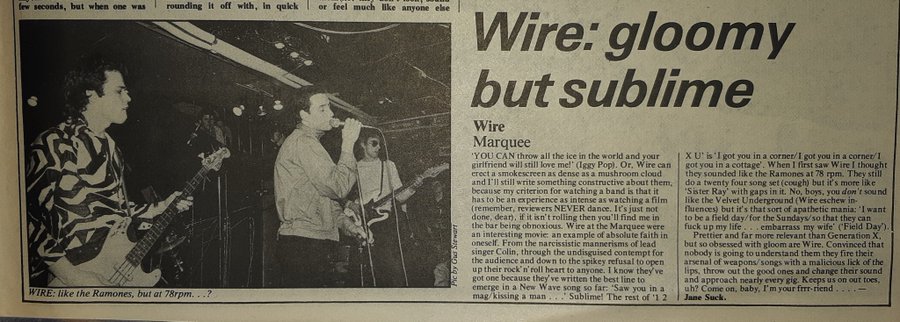
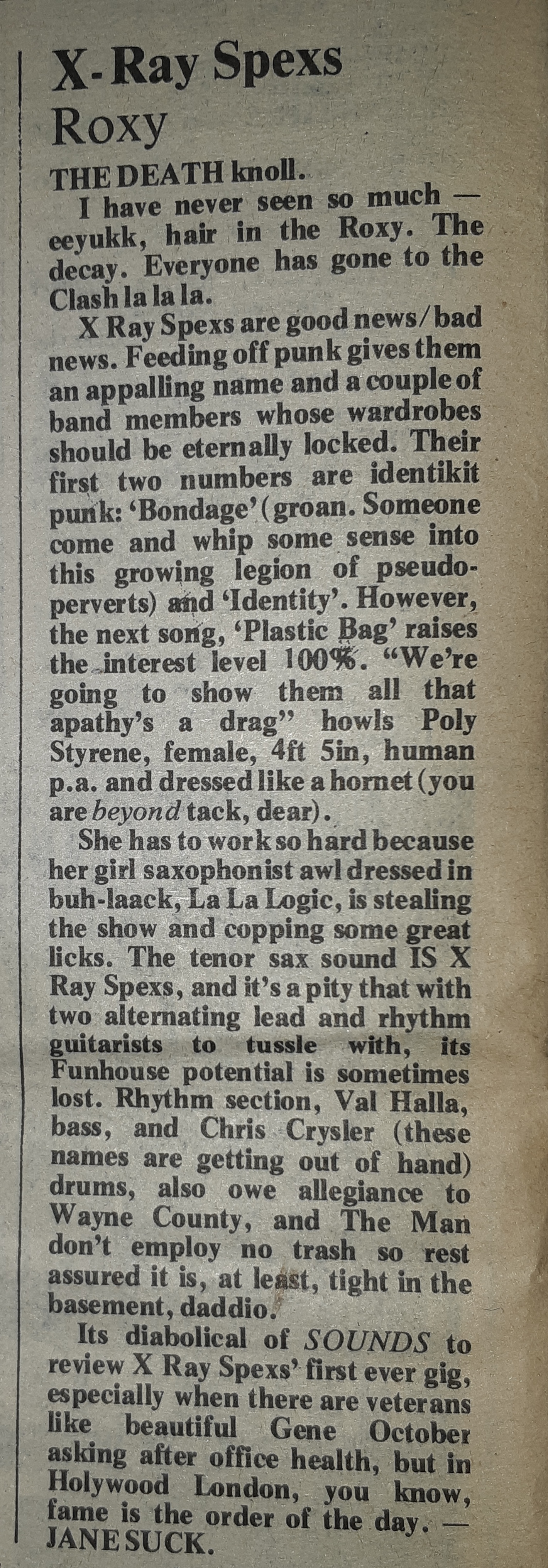
Sounds punk-era legend Jane Suck - who later wrote for NME as Jane Solanas, presumably an alias in homage to Valerie as in SCUM Manifesto - has died. 

Here is Suck's intro / manifesto co-written with Jon Savage for Sounds's landmark New Musick feature package that started November 26 1977 and continued  on December 3 1977.


And here is a piece she wrote as Solanas that is markedly different - a sympathetic take on Kate Bush at a time when the music press still largely scorned her as a kook with an overly dramatic / decorative and passe style of art-rock.  ( Indeed even in the dek / standfirst, written no doubt by some male editor, they can't resist getting some digs in: "Kate Bush has moulded herself in an icon of pop erotica — so much that suburban couples claim her breasts stimulate their love making. Yet to like her voice and music is the ultimate in being uncool. Jane Solanas decides to give Kate the benefit of the doubt." )
Scans first, followed by the text


KATE BUSH profile

NME October 15th, 1983

by Jane Solanas


"Dear Kate

I love you. My brother is in the army and he's a git. I couldn't tell anyone else that. And no one else seems bothered about soldiers getting blown up young. I know you care. I just don't know you…"


"Dear Kate

Me and my wife watched you on the tele and we found your breasts stimulate our love-making…"


"Dear Kate

Your being Roman Catholic interests me…"


^^^^^^^^^^^^^^

There is the school of thought that Kate Bush is for mums and dads. Freakily lovable. The ET of pop — something to laugh at when females impersonate her on TV by donning explosions of brown wig, making stabbing actions with their hands, all the while wailing like a cat fight.

And there's a school who believe Kate Bush is "profoundly subversive", like Fred Vermorel.

Fred — more familiar to NME readers as Malcolm McLaren's old philosophical sparring partner, and co-author of a brilliant book, The Sex Pistols File — for some reason, freaked on Kate's nipples, which stuck out on the first EMI promotional poster, and went on to weave an almost demi-goddess identity for her, largely drawn from the rustic history of the Bush clan and Kate's turbulent schooldays. (EG: why did Kate never fight back when girls pulled her hair?)

But among a younger generation, the school of thought seems to be that liking Kate Bush is about as hip as owning a set of Melanie albums or else that she is… wonderful.

Someone at EMI said:" I 've yet to see anyone sum Kate Bush up."

Kate Bush said: "The thing I don't like about NME is it seems so cynical…"

Those are the two main problems.

^^^^^^^

It would be so easy to be horrible about Kate Bush. A hundred, even affectionate, jokes immediately come to mind.

The press tend to think Ms Bush is immune to satire, innuendo and downright rudeness. Somehow it's alright for Simon Bates to phone her up live on Radio 1 and bellow down the receiver about Kate's bank balance and sex life. The press can always say, "fuck you, you turgid cretin", but a household name is trained to be polite. It's a shame.

But on the other hand, Kate Bush is enigmatic, and what do you do when you don't understand someone? Either attack them ("Kate Bush is a spaced-out druid with lush tits…" is a familiar cry), or build fantasies around them a la Fred Vermorel.

I fell foul of the latter approach. I had so many preconceptions about the woman it was becoming painful. I expected her to be into horror movies, astrology, mysticism and sex, and based my questions around those subjects. I also expected her to have a sense of humour that would have me rolling in the aisles. I asked about the Kate Bush sense of humour at EMI and was told, yes, it existed but it was "off the wall". Unfortunately, it seemed to be out of the room when I was present, but then I shouldn't have expected a side-show.

I don't think the press would get Kate Bush so wrong, if she did not marry her music, which is strong enough already, to a controversial visual presentation. We've all got an instant picture of Kate Bush to draw on: "Oh yeah, she dances, don't she?" being another familiar cry. But think about it, how many dancing songwriters can you count on one hand?

Kate Bush has been somewhat dogged by her past, particularly in the light of the fact that she has been out of the public eye for over a year and her last major tour was as long ago as 1979. Hence impressions of Kate tend to be hopelessly outdated.

I never saw Kate Bush live, and had no interest in her work until the release of the 'Sat In Your Lap' single, so I asked EMI to show me some videos. I watched the Hammersmith gig from '79 and got a total shock: all Kate's songs which were finely imprinted on my brain were transformed into something straight out of Salem's Lot.

I got the impression that the 21-year-old Kate Bush was trying to be Peter Pan, but to me she came across as Varoomshka crossed with a vampire. It was genuinely frightening watching Kate stalking around the stage in various strange garb being man handled by two male/slave dancers, and pulling pained expressions with that extraordinary face of hers. Subtle it wasn't.

Four years on, Kate has calmed down a bit. I watched a preview of her Single File video; as might have been predicted, she is in her element on video. There's still quite a lot of frantic arm waving (and jeezus has she got a pair of arms!), but when she interprets her later material, she's easily one of the most entertaining musicians on film. The one's to look out for are: 'Army Dreamers' (see Kate get blown up), 'There Goes A Tenner' (see Kate blow a safe), 'Sat In Your Lap' (see men wearing goats' legs) and 'The Dreaming' (see God?).

Kate Bush hit her artistic peak on The Dreaming album. Yet sadly it wasn't recognised as an important or courageous album, and caused more confusion than fuss. The three singles taken from it, 'Sat In Your Lap', 'The Dreaming' and 'There Goes A Tenner', were her finest ever and sounded to me like sure-fire radio hits. But the Radio 1 DJs (except David Jensen) tittered nervously, and 'The Dreaming' just about did the whole station in.

She blew away that MOR' Wuthering Heights' image by changing her voice (lowering it) and injecting aggression into the music. There's a note on the bottom of The Dreaming album instructing you to play the record LOUD! Before, Kate Bush as a flaming great noise would never have occurred to anyone.

Kate Bush has always been a unique talent on the music scene. Her individuality and imagination are unusual in an industry which constantly makes do without either. As a songwriter she has the ability to take intriguing subject matter — yes, Wuthering Heights, Houdini, Henry James' The Turn Of The Screw, aspects of war, anything from aborigines getting mowed down by trucks to soft porn — and condensing it into song.

She wrote one of the best anti-army songs ever ('Army Dreamers'); and, of course, she has that voice, distinctive and constantly changing.

Her attitude to work is interesting. It's well known that the EMI machine has been good to her, allowing an extraordinary freedom in the running of her career. But there is still the pressure to promote herself and she has wilfully taken a back-seat. She spent so much time working on The Dreaming, she knackered herself and scrapped plans to tour. She is currently working on new material, but this is still only at the demo stage, and how long she will spend in the studio throwing her voice of walls is anyone's guess.

She is reluctant to do press because of bad experiences. She seems obsessed with doing things right, be it a performance or a photograph, and she does not seem afraid to wait. I find that a rare quality.

^^^^^^^^^^^

The interview I did with Kate Bush for two hours in a dance studio in South London was marred by the preconceptions I mentioned earlier.

I've got only one clear impression of Kate Bush's personality: she's sweet. She wouldn't stomp on a spider if it was three inches wide and crawling through her hair; she wouldn't shout at anyone no matter how obnoxious they were being. I got the feeling that all the energy other 25 year olds might expend on being sassy, sexy and a minor hell-raiser in order to impress their personality on the world, for her is contained and released in her work.

This is not to say Kate Bush outside of a studio or off a stage is vacuous or innocent, but she is unusually quiet. I saw no trace of the extrovert that comes across in her music: I don't think I gave her enough scope to talk about the things, chiefly her songwriting and her dancing, that she would have liked to.

A lot of the time was spent patiently explaining no, she wasn't into this or that, or no, that was an interesting way of looking at it, but not her way. As a "fan", I was probably cute. As an interviewer, a load of crap.

For example, I liked the way she handled this question:

Fred Vermorel wrote a curious thing about your lacking aggressive emotions. Yet The Dreaming seemed to work because it sounded so aggressive. Can you comment on that?

"I think the last album is about trying to cope… to get through all the shit. I think it was positive, showing how certain people approach all these negative things (war, crime etc). I don't think I'm actually an aggressive person. I think I can be… but I release that energy in work. I think it's wrong to get angry. If people get angry, it kind of freaks everybody out and they can't concentrate on what they're doing."

I thought that was an admirable piece of logic. I wasn't so keen on Kate's surprised dismissal of my question on her sexual identity as a female performer:

I once saw a photograph of you taken from your live tour and you were covered in sweat and licking the barrel of a gun. I found it erotic but frightening, because it was so blatant. (I also accused her, after watching the video of the Hammersmith gig of oozing sex all over the stage.) What, as a performer, are your feelings with regard to an audience's erotic reaction to you?

"I suppose it's something I don't really know about. Your energy on stage dictates the character you are (then). I'm too subjective. I just see me… either I get embarrassed or it's working."

It seemed to be news to Kate that her visual presence might have a dramatic sexual effect on people. I closed that part of the conversation with a muttered, "Well, it must be my filthy mind (chortle)". But later I remembered all the comments I'd heard when I'd told people I was going to meet Kate Bush: "tits" and "naked photographs" being uppermost.

Also, in a later question about her initial press identity, Kate remarked, "When I first appeared the press couldn't handle me in any normal way. I was the girl who sang in a funny voice with — 'The Body'…"

There is a video on the Video File that shows "The Body" to wonderful effect. As you can imagine, I buried the next question, Do you think women get off on you?, in fine flippant style. But I liked her candidness in other areas.

Do you like books?

"Yes. But I'm a really slow reader. Every time I read a good book it's in my head for weeks… like The Shining (Stephen King), that went straight into a song."

We had already established that Kate was a keen film fan when I asked this one:

Do you like gory things or taboo subjects?

"Some taboo subjects definitely attract me… I don't think I do like particularly gory things. Like, Don't Look Now, Psycho (films Kate likes), its not the gore so much as the emotional effect — the distortion. I don't think I'd ever go and see Texas Chainsaw Massacre and Friday The 13th, things like that. It think it's sick. You KNOW everybody is going to die disgustingly. I prefer films that work around the subject, build you up…"

Did you ever go through the hippie stage?

"No. I was just a few years too young. In some ways my attitudes could be associated with the time. I mean, I was growing up in the '60s…" (EG: Kate is well gone on The Beatles).

Were you ever into teenage (fashion) cults. Like a skinhead (titter) or something?

"No. I don't think I ever felt I could be convincing enough in any of the roles."

Do you ever get drunk?

"I don't really like alcohol. It doesn't get on with my body… (But) I've got a strong stomach. I can eat a lot… a great combination of things."

Well, I think it's far more interesting to know that Kate Bush is a gut than that Lena Zavaroni is a Freudian anorexic.

^^^^^^^^^^^^^^

You wouldn't believe how physically small Kate Bush is. After the interview, I looked down at her and, for a split second, I wondered how she'd ever make it across the street, let alone be someone people would like to touch, annoy, know. She lacks the cynicism and mistrust of the '80s, yet she's got a single-mindedness that transgresses all the pitfalls of fashion and falling sales. We should stop bugging her.


^^^^^^^^^^^^^^^^^^^^^^^^^

And here is Solanas reviewing a book by her erstwhile hero / ally / role model (?) Julie Burchill


^^^^^^^^^^^^^^^^^^

More Jane Suck through the auspices of Sounds Clips