From those crazy New Pop days when everyone was competing for the most startling transvaluation...
But you know what?
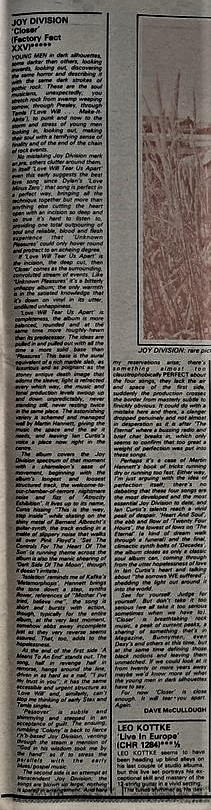
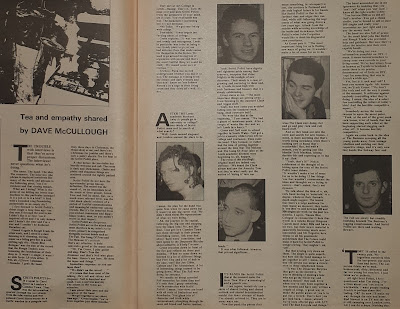
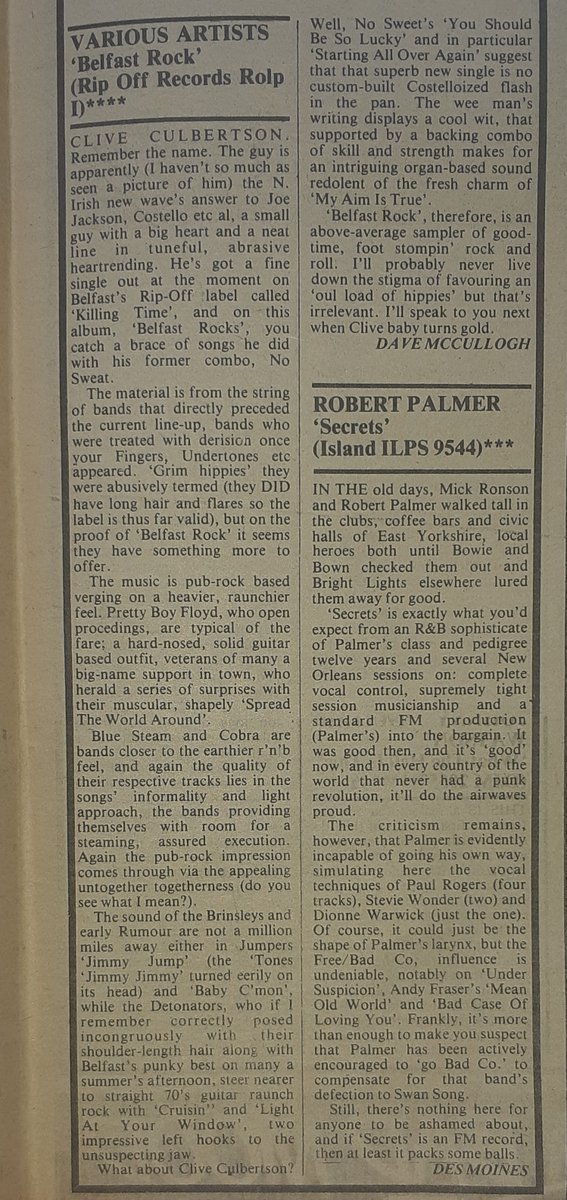
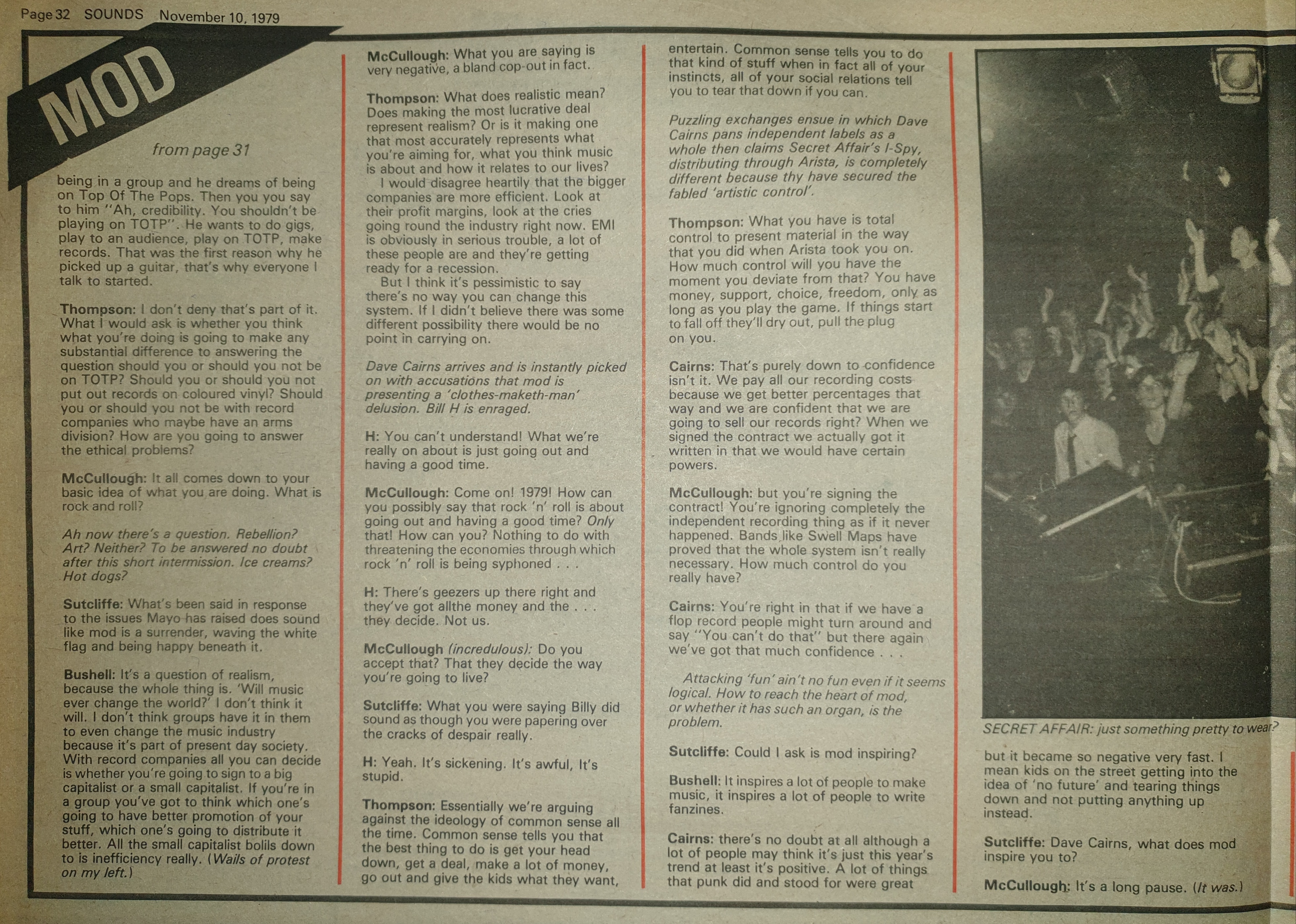
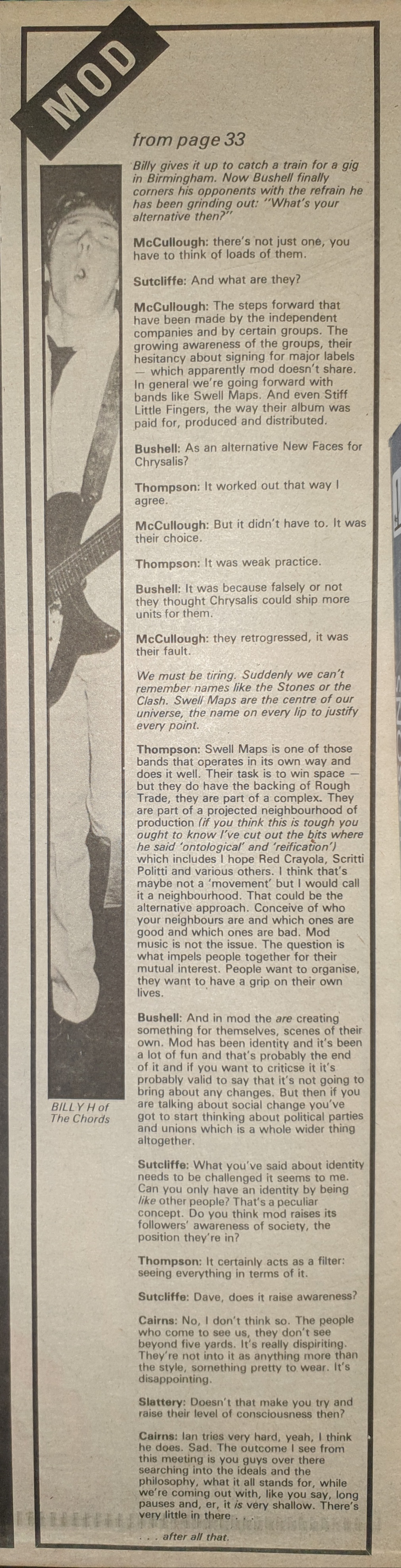
Dave McC (and Ross Middleton of the godawful Leisure Process) are right
The intro to "Too Shy" is gorgeous... And I thought that at the time.
(Both are way off in their counting, though - Ross says it's "the first ten seconds", Dave says it's fifteen - it's actually 45 seconds of delicious elasticated suspense).
There's an equally wonderful patch of airy-aqueous Level 42-aspiring fusion-cloaked-as-pop in the middle of "Too Shy", at around 2.16 minutes - misty curls of sustained guitar floating across the mix that could almost be John Martyn.
The song itself is promising: a subtle shimmy-shimmer through the verse, and even that odd "hey girl move a little closer" pre-chorus is enjoyably New Wave weird. But then all fizzles out with that rabbit-punch-feeble-chorus.
"Ooh To Be Ah" as pop James Joyce? A dare too far for me, but you have to salute the provocation
Lovely to see the former champion of Postcard turn against Orange Juice and Aztec Camera for their drift towards rockist orthodoxy...
Critics moved so fast those days, nothing stood in their way - values were provisional, metrics unstable, stances susceptible to reversal... whether through a major rethink or a skittish impetuous whim

In February 1982, Paul Morley reviewed live concerts by three groups across three weeks - Haircut 100, Altered Images, Depeche Mode. Groups generally deemed among the flimsiest of the New Pop offerings of the time. The review trilogy was aimed as a series of goads goring the sober-sides of aging Clash fans and grey overcoats still mourning Joy Division. It's a tour de force of provocative - and genuinely thought-provoking - transvaluation, celebrating surface pleasures, frivolity, disposability, while gleefully rubbishing ideas of substance, seriousness and durability. Note the appearance of the word "post-rock" in these reviews, meaning something quite different from what it would in the '90s.
It's interesting to think what became of these three groups and how unexpected some of their trajectories would prove to be from how they appeared in '82. Thoughts about that below, after the Morley reviews...
HAIRCUT 100
Kilburn
New Musical Express, February 6 1982
by Paul Morley


ALTERED IMAGES
Hammersmith Palais
New Musical Express, February 13, 1982
by Paul Morley

DEPECHE MODE
Hammersmith Odeon, London
New Musical Express, February 20 1982
by Paul Morley
FAST FORWARD TO THE FUTURE!
To conclude my important three part examination of the
wonderfully unbrutal and irrationally enchanting post-rock teenEEbop
ideologies... BOYS AND GIRLS, the living resonance, the no mere ornament, the
fresh air, the dashed flair, the motiveless action, the living plasticity of
Depeche Mode Boys say go! A rejection of all forms of elitism! So sure of their
salvation! An eclectic imagination that celebrates the untrammelled future! The
fine delight!
Seen from one direction, Depeche Mode's 'innocence' and
'innocuousness' must seem a particularly irritating and sterile little thing: a
tiny thing, an almost invisible, unnatural thing. Those very ill people only
ever look at things from one direction and so as usual they miss out on all the
special side-effects and glorious incidentals that make new pop groups like
Depeche Mode so joyous and luminous and EXTREMELY INCONGRUOUS. I have learnt to
look at groups like Depeche Mode from at least 100 directions: but then, I'm
not ill, and I will not let Depeche Mode get me down...
I see that they are helping break down conventionalised
responses to the world, re-working and revitalising with a soulful, sighing
skill the impulsive, frivolous qualities of the traditional pop song,
reflecting sarcastically on their own role and image of themselves, overcoming
spectacularly the dismaying rockOH dogma, learning to love ironically the
technology that gives them their means and gets them earning. When I look at
Depeche Mode I see strange shapes, angelic precision, diamond brilliance, infinite
possibilities, in actual fact I see a very NATURAL THING... sort of — and I
wouldn't want this all the time, of course — an art without suffering,
spiritually healthy, unceremonious, not mournful and yet confidingly friendly,
an art which exists in terms of it's utmost familiarity with mankind. I don't
say that Depeche Mode are making heroic efforts to extend human application:
but their playful nonchalance — very Dada, don't you think — and their
exaltation of love as the supreme manifestation of the pleasure principle is
one hell of a smack into the eyes and teeth of the mediocrity of the universe.
As you can see, I will not let Depeche Mode get me down. I
leave that to The Resigned, who bow to a very strangled kind of necessity.
Superficially tidy, the surface hides much that is authentically doubtful and
unpredictable — just below the surface of Depeche Mode are very valid and
uplifting energies. Depeche Mode — as with all post-rock teenybop groups — are
empty ONLY TO EYES WHICH DO NOT KNOW HOW TO DISCERN THE HIDDEN PATTERNS i.e.
those very ill people, who someHOW remain dead earnest amidst the gleaming,
audacious, defiant, redemptive power of groups like Depeche Mode I say this:
Depeche Mode and their particular MIRACLE OF SIMPLICITY is enough on its own to
fill me with some kind of enfolding radiance — let that be known!
Anyone who could sulk all the way through Depeche Mode's
kissing, tingling, IMMEDIATE show at Hammersmith Odeon must be very ill indeed:
and of course their sulks don't make a damned difference, to the life inside
Depeche Mode, to the new waves of energy Depeche Mode are contributing to.
There is no absence of wit when Depeche Mode are on stage. "Life,"
they imply, "is neither good or bad: it is original " Based in this
premise, their songs are preoccupied with unpredictability, surprise and
discovery and underpinned with an almost comic jauntiness. The songs have young
bodies and an intense vivacity. Depeche Mode have refined as well as anyone the
pop choreography of transience. For the moment: only a moment. The reds,
greens, blues, pinks, yellows go flashing by: the fleeting moment, the
kaleidoscopic light of changing environment and circumstance, the kaleidoscopic
speed of changing perception... Depeche Mode songs are thoroughly on the brink
of 'a' — rather than the — next moment. So absolute: so arbitrary.
Depeche Mode left the air mild, but spinning with colour and
sensation. They wrecked the cliché that an electronic group can only be bland
and wistful on stage, or that a synthesiser group empties life of spiritual
content, through the sheer suggestive consistency of their transmission and the
energetic business of their presentation. They did Gerry and the Pacemaker's 'I
Like It' as a third encore and everything fell into place.
They are the boys who want tomorrow, with the best will in
the world.
^^^^^^^^^^^^^^^^^^^^^^^^^^^
So what become of these transient thrills of '82, New Pop's annus mirabilis?
Depeche Mode had the most surprising shift of direction, the most unexpectedly long-lasting career. All their dinkiness seemed to depart with Vince Clarke (into The Assembly and Erasure, shudder). Depeche quickly became a Serious Band, inheritors of the Clash and Gang of Four, railing against Thatcher and money-minded values and almost methodically ticking off the boxes of Big Issues to Tackle (they did racism and other-hatred, religion). They deconstructed the Love Song and critiqued Love as a distraction, in the very Gang-of-Four-y "Love, In Itself". They flirted with transgression: the Swans-gone-synth of "Master and Servant", the God-renouncing "Blasphemous Rumours". As the lyrics grew ever more serious, the music grew ever more sophisticated. Live, they became a kick-ass band, rocking huge crowds at American stadiums like the Pasadena Rose Bowl (capacity 70 thousand). Then, in the early '90s, Depeche veered in an outright rocky, blues-grinding direction around the time of grunge; Gahan became a junkie in the most cliched rock'n'roll LA way. Depeche turned out to be one of the most influential bands of their time - big everywhere but especially huge in importance in Central and Eastern Europe.
Haircut 100 had the briefest career. Yet in some ways, right from the start, they were the most rockist of the bunch. They could really play, and some of the band had clearly been listening to things like Average White Band and Steely Dan, even if the template for Pelican West is pretty much Talking Heads '77. In NME, Danny Baker - champion of Chic and Earth Wind & Fire, scornful sceptic about whiteboy discofunksters like A Certain Ratio and Gang of Four - gave Pelican West a rave review - said these boys really had their chops down. Nick Heyward went solo while the residue released a second H100 album, Paint and Paint, which disappeared without a trace. Heyward later on winded up recording for Creation Records of all places - the most rockist, or more precisely, rock'n'rollist of labels.
Altered Images did a second album in their bouncy fizz-pop mode and then went for a drastic make-over with the sexed-up, glammed-up, all-grown-up Bite and its singles "Don't Talk To Me About Love" and "Bring Me Closer". Then it all fizzled out, and to be honest I'm not really sure what happened to Clare and the boys after that. But of these three groups, it's their songs - "Happy Birthday", "I Could Be Happy", "See Those Eyes" - that I'd be saddest to never hear again.
^^^^^^^^^
Morley comes back for a second bite of the live cherry with this review of a bizarre lineup that combines Bauhaus and Clare's crew.

The Bauhaus is also a second go-round (sort of kind of part of the Poptimist Trilogy, or an extension to it, were the belittling live reviews of Peter Murphy's lips and Kirk Brandon's ears).
Morley savagely retracts - bitterly retracts - biliously retracts - his previous esteem for the pop genius of Nick Heyward upon the arrival of the lad's solo debut in October 1983, North of A Miracle fair suppurating with soft-rockism


Ray Lowry
Titanic Refloated
New Musical Express, June 20 1981

Ian Penman
Titanic Resunk
a.k.a. Political Conscience Every Now and Then. Pub Every Night. NME Every Week.
New Musical Express, June 17 1981


Unusually clearcut for the Punman then - and a piece that did some rewiring of my ideas in those formative days, so deftly did it demolish the quaint 'n' clunky idea of politics + pop that the Lowry tirade wished to restore, with such clumsy yearning (stick to the cartooning, boy, you're ruff at that).
I believe this is the last of the Titanic-themed pieces that NME did.
Missing from the sequence: the proto-Titanic piece that Mick Farren wrote at the very start of 1976, a sort of warming up to the theme of "things have gone adrift". I feel that I have at some point read that proto-piece, but where it would be and how to get my hands on it, I'm not sure....

Unabashed by being thrashed, in October 1981 Lowry continues to demand generational voices of angry sanity from within the ranks of rock.

"I promise I'll be funny again soon - when the economy looks up"
A reader dresses down Lowry


Part of Morley's 1982 quintology of anti-rockist live reviews - this is a warm-up for the more infamous outrage that was his Bauhaus live review a.k.a paean to the lips of Peter Murphy the following week (March 6 1982)


note early use of the term "post-rock" here
part 2 of a trilogy of live reviews poking rockists in the eye by celebrating the fluffiest frivolousest lightestweight of pure pop concoction (the others were Haircut 100 and Depeche Mode)
even better understood as part of a quintology of antirockist live reviews alongside the infamous / legendary Bauhaus one that declared that the only good thing about the band is Peter Murphy's mouth and the infamous / legendary Theatre of Hate review that asserted that the only good thing about the band is Kirk Brandon's ears - offensively trivializing the "serious" = opening up another front in the popist versus rockist war




.jpg)
.jpg)


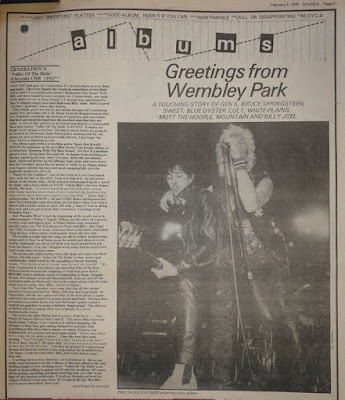
Bobby Gillepsie riposte in the Letter Page re Dave McC's Generation X slag-off











 |