Continuing the series of reviews where critics get wrong-footed in their real-time reactions to an album, here is Dave McCullough mystifyingly underwhelmed by Siouxsie and the Banshees's A Kiss In The Dreamhouse. If not indisputably their best album, it's certainly right up there, and it's definitely their most expansive and experimental effort - but here it gets a measly three stars and is judged to be a misfire..
I also found it puzzling that he harps on about John McGeoch as the record's star and saving grace, because it doesn't leap out to my ears as a guitar-dominated record... McGeoch is much more the forefront dominant on Kaleidoscope and Juju, I'd have said.
Not quite an example of critics totally missing the significance of an epochal record in real time, as this does get a measured 3 and a half stars out of five from Gaz, with Entertainment! further described as "erratically brilliant".
Included in the series more because the critique comes from a well-informed position (SWP member conversant withBrecht etc) yet advances a stance contrary to the now historically sanctioned viewpoint (here it is arty postpunk that's deemed is the wrong direction out of punk, the diversion of energy). Instead of "rip it up and start again", it's more like "reiterate it and stay street".
Continuing the series of critics getting it wrong in real-time, not divining the significance of a release or artist... here's Rose Rouse in Sounds underestimating Kate Bush's The Dreaming.
Still, in mitigation, it would have to be said that Rose was not alone here - in fact Bush had almost zero critical support from the thinking person's press at this time - that all came with The Hounds of Love
And as slag-offs go, it's well argued and even somewhat convincing.
Continuing the series of critics missing the significance of a record on its initial release - here is Lester Bangs in 1976 with what is ostensibly a review of Agharta but is really a panoramic takedown of Miles Davis after In A Silent Way. It's included here mainly for its utterly wrongheaded take on On The Corner and similarly dismissive reaction to Get Up With It.
Originally published in Phonograph Record in June 1976, the piece was reprinted in NME in 1983 as a tribute following Bangs's death and that's what is reproduced here (to read it in full you might need to download the images - but there is a portion of it in text form below).
By the end of the 1970s Bangs completely changed his tune and decided that On The Corner was genius and in some piece or other (corralled in Psychotic Reactions) declared that he would stake his writing life on Get Up With It and Metal Box.
Nowadays you will get lists that place On the Corner as #1 Miles album.
".... But here I sit, nearly three years later, and this man and
his music refuse to ease their stranglehold on my tastes, more, my emotions. I
am obsessed with him because he once released Sketches of Spain, which contains
an adagio passage in Rodrigo’s ‘Concierto De Aranjuen’ which may hold more
distilled sorrow than any other single solo by anyone I have ever heard; I am
obsessed with him because Kind of Blue, like Birth of the Cool a decade
previous, defined an era and produced some of the most beautiful, spacious,
expansively inspired music it was to know; I’m obsessed because In a Silent Way
came close to changing my life, reinstalling a respect for the truly spiritual
aspects of music when I was otherwise intent on wallowing in grits and metal;
I’m obsessed, simply because he is Miles, one of the greatest musicians who
ever lived, and when a giant gets cancer of the soul you have to weep or at
least ask for a medical inquiry.
Which is why I have been studying Miles’ work for the past
year or so, trying to figure out where (if?) he went wrong. Think about the
fact that this guy has been making “jazz” records since the late Forties, and
that many of them, way more than any single musician’s share, have become (to
borrow the title of one) milestones. The man has defined at least three eras in
American music – can Dylan say the same? Never mind that when In a Silent Way
came out it had the same effect as Charlie Parker’s renaissance and influence
on his followers – i.e., it ruined a whole generation of musicians who were so
swept by its brilliant departure that they could do nothing but slavishly
imitate so every goddamn album you heard dribbled the same
watered-down-kitsch-copy of Miles’ electric cathedral – it remains that now,
seven years later. In a Silent Way not only has not dated but stands with
Sketches of Spain and a few other Miles albums as one of the sonic monuments of
our time. And that’s neither hype nor hyperbole.
But since then, the years, private problems, celebrityhood,
hipper-than-thous – something, whatever, has taken its toll. On the Corner was
garbage. So was, with the possible exception of one bit I have been told about
but am unable to find in its four unbounded 30-minute sides, Miles Davis in
Concert, Big Fun and Get Up with It were largely left-overs, with predictably
erratic results. The former’s “Go Ahead John” was a cooker, but too much of the
rest was something never previously expected of Miles, simple ideas repeated
for whole sides, up to a half hour each, in an electronicized receptiveness and
distortion-for-its-own-sake that may have been intended as hypnotic but ended
up merely static. What was perhaps even more disturbing was that once you got past
the predictability and disappointment and analyzed the actual content of the
music, it took Miles past his traditional (and traditionally heart-wrenching)
penchant for sustained moods of deep sadness into a new area redolent more of a
by turns muzzy and metallic unhappiness. He should have called one of these
albums Kind of Grim. And mere unhappiness, elaborated at whatever
electro-technocratic prolixity, is not nearly the same as anguish.
Much of Miles’ finest music, from Blue Moods to “Prayer” on
Porgy and Bess to Sketches to My Funny Valentine, has been about inner pain
translated into a deep mourning poetry so intense and distilled that there have
been times when I (and others have reported similar reactions) have been almost
literally unable to take it. I have always been offended when people ask me to
take off any jazz record because they find it “depressing,” but secretly I
always knew what they meant. Because there were times when I found Miles’
anguish not purgative but depressing, when I had to yank Jack Johnson out of
the 8-track deck because I could not drive to the laundromat with such a weight
on my heart; but I also knew the reason why I (and, if I may be presumptuous,
the nebulous anti-jazz people I just mentioned) was depressed: because at that
moment there was something wrong with me, of a severity that could reach by
degrees from my consciousness to my heart to my soul; because I was sweeping
some deep latent anguish under the emotional carpet, or not confronting myself
on some primal level – and Miles cut through to that level. His music was that
powerful: it exposed me to myself, to my own falsity, to my own cowardice in
the face of dread of staved-off pain. Because make no mistake, Miles
understands pain – and he will pry it out of your soul’s very core when he hits
his supreme note and you happen, coincidentally, to be a bit of an open
emotional wound at that moment yourself. It is this gift for open-heart surgery
that makes him the supreme artist that he is. So, obviously, I am damned if I
am going to shrug him off at this point. I am going to tear these fucking
records apart and find out what the source of the cancer running through them
is, praying for cure....."
He's not wrong about the soul-sickness in Miles's music of the 1970s... but for the life of me I can't see why he didn't recognise that this made this music compelling, a puzzle worth solving.
^^^^^^^^^
Here as a chaser is Bangs getting it right in real time: a rhapsody about In A Silent Way for Rolling Stone.
Miles Davis
In A Silent Way
by Lester Bangs
This is the kind of album that gives you faith in the future of music. It is not rock and roll, but it’s nothing stereotyped as jazz either. All at once, it owes almost as much to the techniques developed by rock improvisors in the last four years as to Davis’ jazz background. It is part of a transcendental new music which flushes categories away and, while using musical devices from all styles and cultures, is defined mainly by its deep emotion and unaffected originality.
Miles has always gone his own way, a musician of strength and dignity who has never made the compromise (so poisonous to jazz now) with “pop” fads. It is a testimony to his authenticity that he has never worried about setting styles either, but continued his deeply felt experiment for two decades now. Albums like Miles Ahead, Kind of Blue and Sketches of Spain simply do not get old, and contain some of the most moving experiences that any music has to offer. In his new album, the best he has made in some time, he turns to “space music” and a reverent, timeless realm of pure song, the kind of music which comes along ever so often and stops us momentarily, making us think that this perhaps is the core around which all of our wayward musical highways have revolved, the primal yet futuristic and totally uncontrived sound which gives the deepest, most lasting sustenance to our souls, the living contemporary definition of great art.
The songs are long jams with a minimum of preplanned structure. That they are so cohesive and sustained is a testament to the experience and sensitivity of the musicians involved. Miles’ lines are like shots of distilled passion, the kind of evocative, liberating riffs that decades of strivers build their styles on. Aside from Charles Mingus, there is no other musician alive today who communicates such a yearning, controlled intensity, the transformation of life’s inchoate passions and tensions into aural adventures that find a permanent place in your consciousness and influence your basic definitions of music. And his sidemen also rise to the occasion, most of them playing better than I have ever heard them before. Certainly Herbie Hancock (piano), Wayne Shorter (tenor sax), and Joe Zawinul (organ) have never seemed so transported. The miracle of jazz is that a great leader can bring merely competent musicians to incredible heights of inspiration —; Mingus has always been famous for this, and Miles has increasingly proven himself a master of this incredibly delicate art.
The first side is taken up by a long jam called “Shhh/Peaceful.” Tony Williams’ cymbal-and-brush work and the subtle arabesques of Zawinul’s organ set a space trip, a mood of suspended time and infinite interior vistas. But when Miles enters, the humanity and tenderness of his trumpet’s soft cries are enough to bring you tears. I’ve heard that when he was making this album, Miles had been listening to Jimi Hendrix and Sly and the Family Stone, but the feeling here is closer to something like “2000 Light Years From Home” by the Stones. It is space music, but with an overwhelmingly human component that makes it much more moving and enduring than most of its rock counterparts.
Side two opens and closes with the best song on the album, a timeless trumpet prayer called “In a Silent Way.” There has always been something eternal and pure in Miles’ music, and this piece captures that quality as well as anything he’s ever recorded. If, as I believe, Miles is an artist for the ages, then this piece will be among those that stand through those vast tracks of time to remind future generations of the oneness of human experience.
Between the two takes of “Silent Way” lies “It’s About That Time,” a terse, restrained space jam somewhat reminiscent of the one on the first side but a bit sharper, allowing more of Miles’ fierce blues ethos to burn through. This is the one that might be connected to Miles’ interest in Hendrix and Sly.
They say that jazz has become menopausal, and there is much truth in the statement. Rock too seems to have suffered under a numbing plethora of standardized Sounds. But I believe there is a new music in the air, a total art which knows no boundaries or categories, a new school run by geniuses indifferent to fashion. And I also believe that the ineluctable power and honesty of their music shall prevail. Miles Davis is one of those geniuses.
^^^^^^^^^
Not one of his great reviews - often in praise mode he over-relies on these windy vague terms, a rather standard lexicon of humanist-literary approbation. “Timeless”, “heights of inspiration”, “the oneness of human experience”. Almost a sense of being intimidated by the subject.
^^^^^^^^^^^
And here's me with the benefit of hindsight - but well before it became a fashionable opinion - bigging up OTC. August 17 1991, Melody Maker
Some windy, lofty lingo in there - and below too.
From a few years earlier - September 2 1989 - a paean to Silent Way.
Not sure which publication this was in - probably International Times - but this could be the start of a sporadic series: reviews in which critics don't perceive the significance of something at the time of its release.
Interesting, though, that the one track Farren digs and praises is "We Will Fall" - the track that most Stooges fans find tedious and interminable.
Contradicting his own point, it also the one with the least "live" energy.
But he's right - "We Will Fall" is a great track, precisely for its droning narcotic lassitude - the absence of kinetic-ballistic energy. Attributing it all to John Cale strikes me as unfair, but it does indeed resemble The Marble Index relocated to Michigan.
Personally I never had any problem with its protractedness or inertia - always loved it. Plus it functions similarly as side-one ender to "Dirt" on Fun House.
It's an atmosphere to sink into. An ambience somewhere between an opium den and a temple. Sinister ceremonies, rituals of annulment. It could go on for ever.
"Ann", on the flipside, starts with a similar kind of limpid limpness - before erupting (erecting) with rampaging desire.
What's this "Dance of Romance"? Presumably an ironic title - courtship, wooing, seduction, cloaking the animal reality.
Possibly the accusation - "Emotional Fascism" - seems in retrospect a little harsh, considering what Dexys soon became (jolly jigsters circa Too-Rye-Aye.... harmless has-beens / heroes-to-some thereafter...). Also in light of Rowland's evidently troubled soul.
Still, as a real-time reaction of repugnance, this is forcefully argued, I think
For the June 29 1996 issue, Melody Maker investigated the phenomenon of "Yob Rock", convening a round table that has a number of people representing ladpop and ladette-pop but also a rather large contingent of Romo musicians and Romo-writers, who deplore the Loaded-ladded culture.
There's also a sort of historicising thinkpiece about the yob tradition in British rock by Taylor Parkes
The Yob Rock debate - Orlando members and Romo-in-spirit Placebo singer plus Simon Price critique the ladpop, while Ben Stud + some lad and laddette performers retort that this is elitism and snobbery and stereotyping
I think is actually the UK music press at its best - purely ideas-oriented and ideals-oriented argumentation - flashbacking to similar debates about e.g. Synths in Pop, or the New Mod, that Sounds might convene.
It gets pretty fiery.
Ben Stud: "Romo.... was a comprehensive failure" from the most acrimonious bit of the exchange
You might draw some discomfiting conclusions from the fact that in this Lads versus Dandies furore, the women present barely get a word in edgeways.... suggesting that Cavaliers versus Roundheads is just a fratricidal battle within the Patriarchy - Sons versus Sons.
In following weeks the surviving Romos out there bite back at the Yob Champions
- but futilely.
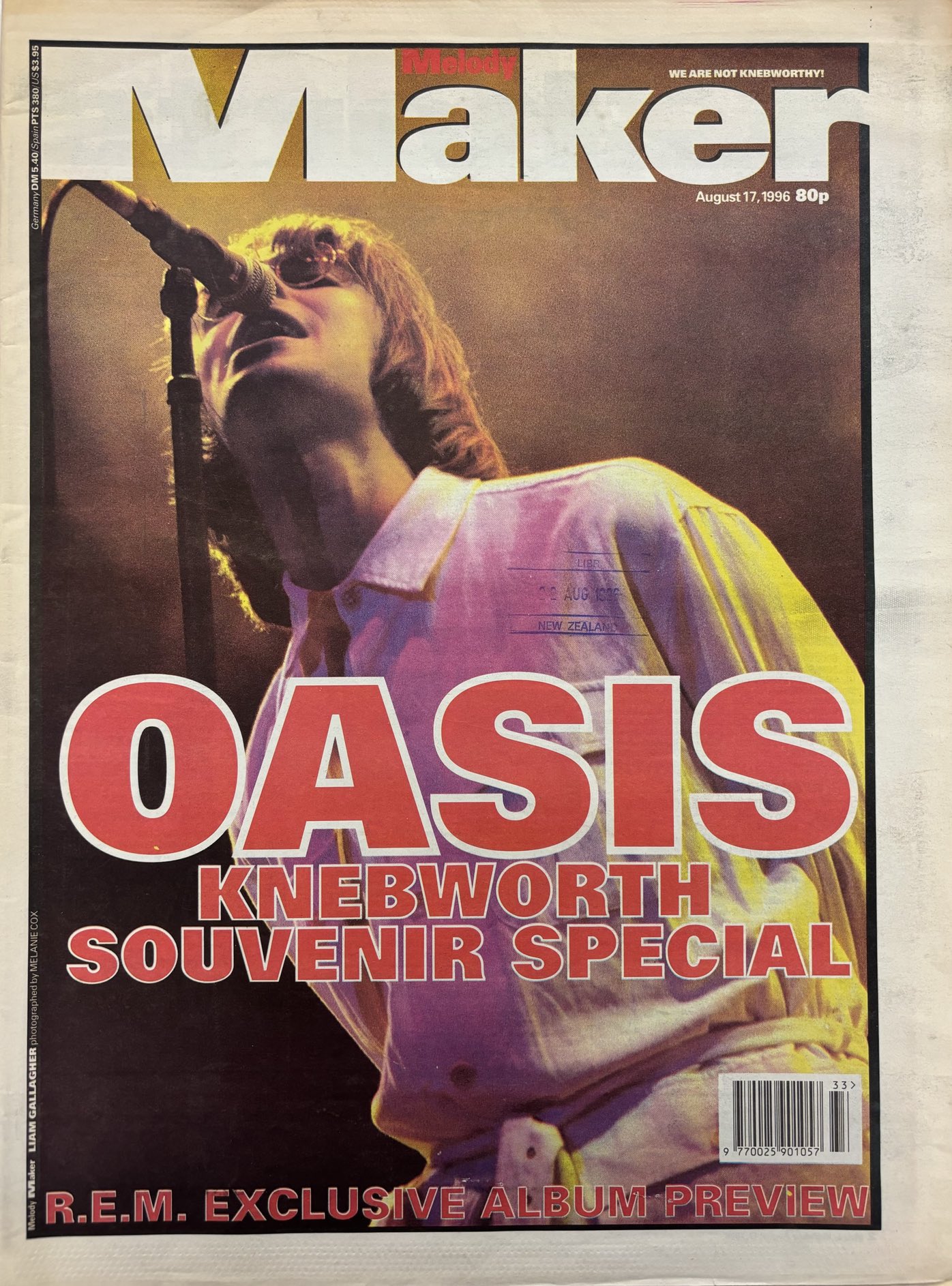
And then Oasis have the front cover for two issues in a row - Loch Lomond and Knebworth
Followed, with a week's interval (Ash) by The Stone Roses
(At Knebworth, John Squire joined Oasis on stage)
And then this!
A brief flicker of Romo-adjacent ambiguity
And then Oasis again!
This cover is the bookend to an early cover from April that year
Ladrock's grim hegemony maintains
(1996 was really a dead-arsed year when I think back to it - outside of dance music and R&B)
This is the maxi-version of this earlier mega-post at Shock and Awe on Romo as the Re-Renaissance of Glam
I remember Romo fondly as the last blast of the old-style weekly music press - a scene willed into being, semi-fictionalized, born aloft on the rhetorical efflorescence of its champions
The product of hype in its purest sense - the job we music journos do for the sheer sport of it
The original Romanifesto, penned by Simon Price and Taylor Parkes, is a classic of the genre
Wilde at heart!
Nothingelseon, heroic scanner and tweeter of the UK weeklies, has recently gone through that period and what has surprised me with each weekly deposit is the extent to which Melody Maker continued to throw its weight behind the movement through late '95 and deep into the following year
There was a MM-associated tour of the UK with the leading lights
There was a cassette, Fiddling While Romo Burns...
The big groups on the scene got double-page spread interviews
Also what surprised me is the controversy - the letter page Backlash was full of, well, backlash... romophobia ran rampant... the debate raged right through into the spring of '96
Here, below - because I am little insane - is pretty much the entire run of this twilight-of-the-inkies phenom - from the earliest twinkly inklings, through the Special Issue, and on to the continued coverage .... Singles of the Week.... letters pages fizzing with disapproval, Parkes and Pricey taking turns to fight back ... the big features... a report on the tour from Simon P.... and then finally a backlash, in the form of the Yob Rock issue and subsequent acrimony.
I was in America and missed almost the entire thing, although I do remember on a visit to UK going to a concert at which three of the most touted groups played... I think it was Dexter and Orlando and maybe one other... one group seemed rather Duran Duran circa Rio... overall I wasn't swayed as much as I'd have liked./ I do remember being quite taken with Minty and picking up one of their singles or EPs...
But it hardly mattered if the music substantiated the hype, really... the point was to put the ideas out there, shove them into the mix... and make that grand gesture against the laggardly ligging laddishness of post-peak but still dominant Britpop
A bit of context:
The things that Romo defined itself against, rebuked, flashed garish against the dowdy flock included aforementioned Britpop (now in its Bluetones / Cast / Shed Seven / Northern Uproar / Sleeper phase).... there was also still grunge around... bands like Garbage, superficially brighter and poppier but essentially Viggist... Bis... Skunk Anansie... and there was the faceless brainfood or footfood of drum & bass, post-rock, IDM, Mille Plateaux...
But there were fellow travelers with the Romos in terms of a move towards sharpness and image: Pulp (in their ascendancy)... Moloko.... the EZ listening initiative (the Ratpack-homaging Combustible Edison + Mike Flowers in the charts, travestying "Wonderwall")... the modder faction within Britpop: Gene, Menswear.... neo-glam (70s rather than 80s) flickers from Denim and Earl Brutus... neo-mod suit-wearing from Ian Svenonious's new groop The Makeup.... old glam gods lurching back into action (David Bowie, Boy George, Mark Almond, Human League) and then right there in middle of pop, accidentally aligned with Romo, there was Babylon Zoo... and poking through towards the end of this phase, Placebo
So some kind of gathering rejection of post-grunge and post-Britpop ordinariness was being disparately mounted
ROMO - THE BUILD UP
The first mention of Romo I could find is from June 1995 in this Pricey review which makes Sexus single of the week.
ROMO - THE MELODY MAKER FRONT COVER
x
ROMO RAGES ON (AND ON)
Tips for 1996
By June '96, Romo has pretty much petered out - making for a year of livening up the pages of the paper, since it was June '95 that Pricey's made Sexus's "Edenites" Single of the Week
But mere moribundity doesn't stop the Romophobes rallying to give the good-looking corpse a good kicking
For the June 29 1996 issue, MM investigated the phenomenon of "Yob Rock", convening a round table that contains a number of people representing ladpop and ladette-pop but also a rather large contingent of Romo musicians and Romo-writers, who deplore the Loaded-ladded hegemony
There's also a sort of historicising thinkpiece about the yob tradition in British rock by Taylor Parkes
Below, the Yob Rock debate - Orlando members and Romo-in-spirit Placebo singer plus Simon Price critique the ladpop, while Ben Stud + some lad + laddette performers retort that this is elitism and snobbery and stereotypery
I think this is actually the UK music press at its best - purely ideas-oriented and ideals-oriented argumentation - flashbacking to similar debates about e.g. Synths in Pop, or the New Mod, that Sounds convened around the turn of the '80s.
It gets pretty fiery.
Ben Stud: "Romo.... was a comprehensive failure" (from the most acrimonious bit of the exchange)
You might draw some discomfiting conclusions from the fact that in this Lads versus Dandies furore, the women present barely get a word in edgeways.... suggesting that Cavaliers versus Roundheads is just a fratricidal battle within the Patriarchy - Sons versus Sons.
In following weeks the surviving Romos out there bite back at the Yob Champions
- but futilely.
A few diehards don't want to turn the page
August 31 1996
And Simon Price still flies the flag now and then
That's September 1996
But it won't be until electroclash circa 2002 that Romo-ish ideas get back in the ascendant (and even then they don't go mainstream)
The mainstreaming would come with the re-re-renaissance - and it would be female-led - Gaga, La Roux, etc
“archives of resistance”
-
In June I went to Bristol to do a Still In A Dream event at Strange Brew.
Joy and I were wandering around and saw these posters for jungle raves and
dr...
We are in Kansas still
-
One of the retrospective embarrassments I have with *Rip It Up and Start
Again *is *The Embarrassment *- the non-appearance of the Kansas
(post?)punk gr...
The Old Musical Express
-
*New Musical Express *on the 1983 reissue of *Charlie Gillett*'s 1971 book *The
Sound of the City. *
Reviewer *Paul Du Noyer* notes that "*in...
-
“Art arrived at that point of extreme maturity that determines
civilizations which have grown old; ingenious, complicated, clever, full of
delicate hint...
Applause without ears
-
Came across this review of *Shock and Awe* online and was reading it,
nodding along and thinking '*this is rather perceptive'* and then realised
it was ...
10 Jungle Classics - Mojo - April 1995
-
Note how the copyeditor assumed that the 2 in "2 Bad Mice" was me having
started and abandoned a numbering system but having forgot...
A Telex from yesterday's future
-
An example of what I call "the rhetorics of temporality" - the way critics
compulsively position and reposition things they like, or are...
faves of the 2010s
-
(Tracks not full lengths)
Ke$ha – “We R Who We R”
Ke$ha - “Backstabber”
Ariel Pink's Haunted Graffiti, "Round and Round"
Rangers – “Golden Triangles”...
angel delights
-
https://rada-ve.bandcamp.com/track/saturn-rings-songs
*Go on* - listen to that gorgeous bubble bath of synthtronica!
Another vintage release, with a vi...