Showing posts with label CRITICS GETTING IT WRONG. Show all posts

Monday, July 28, 2025

Lester Bangs on Black Sabbath - stick your wrong foot out, then your right foot in

In the wrongfooted-in-real-time category, this review for Rolling Stone of the debut Black Sabbath album is lacking clairvoyance. I don't have the whole thing unfortunately: 

 "Over across the tracks in the industrial side of Cream country lie unskilled laborers like Black Sabbath, which was hyped as a rockin' ritual celebration of the Satanic mass or some such claptrap, something like England's answer to Coven. Well, they're not that bad, but that's about all the credit you can give them. The whole album is a shuck – despite the murky song titles and some inane lyrics that sound like Vanilla Fudge paying doggerel tribute to Aleister Crowley, the album has nothing to do with spiritualism, the occult, or anything much except stiff recitations of Cream clichés that sound like the musicians learned them out of a book, grinding on and on with dogged persistence. Vocals are sparse, most of the album being filled with plodding bass lines over which the lead guitar dribbles wooden Claptonisms from the master's tiredest Cream days. They even have discordant jams with bass and guitar reeling like velocitized speedfreaks all over each other's musical perimeters yet never quite finding synch — just like Cream! But worse."

That's from September 17 1970. He really bangs away at the Cream connection. This might be where I got the Sabbath as "crude putsch" on Cream idea. Then again I don't remember reading this before...

However Bangs changed his tune / wised up / saw the light pretty quickly. Suddenly he's right-footed-in-real-time, especially as most rock critics continue to hate the Sabs. 

Here's Bangs review of  Master of Reality for Rolling Stone, November 25, 1971: 

The second-generation rock audience (that is, those who went steady to "I Wanna Hold Your Hand" and got serious with Highway 62 Revisited) suffer mightily wrestling with the phenomenon represented by Grank Funk and Black Sabbath. If nothing else, though, both Funk and Sabbath are for all their monotony at least supremely consistent — as opposed to schtick collectors with no personal vision like Deep Purple. And since when is monotony so taboo in rock & roll, anyway? Rock has been — some of the best of it too in large part monotonous from the beginning, hypnotically so, as rightwingers would say. As far apart as they are, Black Sabbath is only slightly more monotonous than James Taylor or Joni Mitchell, and any Stooges or MC5 fan who disdains Black Sabbath is just bigoted.

The thing is that, like all the best rock & rollers since the Pleistocene era, Black Sabbath (and Grand Funk) have a vision that informs their music with unity and direction and makes their simple structures more than they might seem. Grand Funk's vision is one of universal brotherhood (as when they have spoken of taking their millions to the White House with a list of demands), but Black Sabbath's, until Master of Reality anyway, has concentrated relentlessly on the self-immolating underside of all the beatific Let's Get Together platitudes of the counter culture.

Their first album found them still locked lyrically into the initial Spiritualist-Satanic hype and was filled out mostly with jamming, while Paranoid reflected that theme only, in the great line in "War Pigs": "Generals gathered in their masses Just like witches at black masses." The rest of the album dealt mostly with social anomie in general, from the title track's picture of total disjuncture (rendered with authentic power too) to "Iron Man's" picture of an unloved Golem in a hostile world, the stark picture of ultimate needle-freak breakdown painted in the philippic "Hand of Doom," and finally the unique "Fairies Wear Boots": "I went walkin' late last night Suddenly I got a fright/I looked in the window, was surprised what I saw/Fairies in boots dancin' with the broads!"

Not all of this, incidentally, was rendered in La Brea sinks of lugubrious bass blasts — several of the songs had high wailing solos and interesting changes of tempo, and "Paranoid" really moved. If you took the trouble to listen to the album all the way through.

Master of Reality both extends and modifies the trends on Paranoid. It has fewer songs, if you discount the two short instrumental interludes, but it is not that the songs are longer than the first record — the album is shorter. The sound, with a couple of exceptions, has evolved little if at all. The thick, plodding, almost arrhythmic steel wool curtains of sound the group is celebrated and reviled for only appear in their classical state of excruciating slowness on two tracks, "Sweet Leaf" and "Lord of This World," and both break into driving jams that are well worth the wait. Which itself is no problem once you stop thinking about how bored you are and just let it filter down your innards like a good bottle of Romilar. Rock & roll has always been noise, and Black Sabbath have boiled that noise to its resinous essence. Did you expect bones to be anything else but rigid?

The rest of the songs, while not exactly lilting, have all the drive and frenzy you could wish for in this day and age. Thematically the group has mellowed a bit, and although the morbidity still shines rankly in almost every song, the group seems to have taken its popularity and position seriously enough to begin offering some answers to the dark cul-de-sacs of Paranoid. "Sweet Leaf," for instance, shows that Black Sabbath have the balls to write a song celebrating grass this late date, and the double entendre, if you can even call it that, is much less tortuous than it would have been in 1966, with an added touch of salvation from grosser potions: "My life was empty forever on a down/Until you took me, showed me around ... Straight people don't know what you're about..."

 Unfortunately, the religious virus also rears its zealot head, in "After Forever," which is a great Yardbirds-type arrangement nevertheless and despite its drubbing us over the head with "God is the only way to love" it does have the great line "Would you like to see the Pope on the end of a rope?"

 And besides, isn't all this Christian folderol just the flip side of the Luciferian creed they commenced with and look back on balefully in "Lord of This World"? And for those of us, like me, who prefer the secular side of Black Sabbath, there's "Solitude," a ballad as lovely as any out of England in the last year (with flute yet), and "Children of the Grave": with "Revolution in their minds the children start to march Against the world they have to live in Oh! The hate that's in their hearts They're tired of being pushed around and told just what to do. They'll fight the world until they've won and love comes flowing through."

 I'm not saying that either that or the arrangement it's set in is the new "My Generation," but it is a rocking, churning addition to the long line of defiant, self-affirmative and certainly a little defensive songs that goes right back to the earliest whap and wail of rock 'n' roll. It's naive, simplistic, repetitive, absolute doggerel — but in the tradition. Chuck Berry sang in more repressed times. "Don't bother us, leave us 'lone/Anyway we almost grown." The Who stuttered "hope I die before I get old," but the MC5 wanted to "Kick Out the Jams" or at least escape on a "Starship," and Black Sabbath have picked up the addled, quasi-politicized desperation of growing up in these times exactly where they left off: "Freedom fighters sent out to the sun Escape from brainwashed minds and pollution/Leave the earth to all its sin and hate/Find another world where freedom waits."

 The question now is not whether we can accept lines as obvious and juvenile as that from a rock & roll record. They should be as palatable to anyone with a memory as the stereotypic two-and three-chord structures of the songs. The only criterion is excitement, and Black Sabbath's got it. The real question is whether Black Sabbath can grow and evolve, as a band like the MC5 has, so that there is a bit more variation in their sound from album to album. And that's a question this group hasn't answered yet.


And then continuing the Lester as headBangser trajectory, he wrote this high-flown appreciation in Creem, June 1972


I need someone to show me

The things in life that I can find

I can’t see the things

that make true happiness

I must be blind.


—Black Sabbath, "Paranoid"


"The world’s comin’ to an end."


—British bobby, interviewed on network

news in the first bloom of Beatlemania


We have met dark days; the catalog of present horrors and dire morrows is so familiar there’s not even any point in running through it again. It may be a copout, but people will do almost anything now to escape from the pall. The (first) Age of Anxiety gave way to the clammy retreat of the Fifties, when every citizen kept a tight bomb shelter, then to the sense of massive change in the Sixties, but the passing of that agitated decade has brought a new Age of Implosion, yesterday’s iconoclastic war babies siphoned off en masse, stumbling and puking over each other at the festivals which were celebrations such a short time ago. Tying off their potentials and shooting them into the void in bleak rooms.

It’s a desperate time, in a "desperate land" as Jim Morrison said just when things seemed brightest. If the terminal dramas of the Doors and the Velvet Underground were prophetic, their "sordid" plots have now become the banal stuff of everyday life, which certainly doesn’t lessen the pervasive dread, but does imply a new music, a music which deals with the breakdowns and psychic smog on another level and, hopefully, points toward some positive resolution.

We have seen the Stooges take on the night ferociously and go tumbling into its maw, and Alice Cooper is currently exploiting it for all it’s worth, turning it into a circus. But there is only one band that has dealt with it honestly on terms meaningful to vast portions of the audience, not only grappling with it in a mythic structure that’s both personal and universal, but actually managing to prosper as well. That band is Black Sabbath.

Naturally, you can’t pull off something as heavy as that without creating a bit of controversy. Most people are familiar by now with the great Sabbath-Grand Funk vs. rock press controversy (although the press has begun a large-scale reroute in the last year). The band’s first album made the top 20 in England, their second went to number one, the single of its title song made number three on the British charts, and by the time they came to America their record company was ready with a hype fronted by "LOUDER THAN LED ZEPPELIN" banners, though, as lead singer Ozzy Osbourne says, "They had to drop that fairly soon because we just told them not to **** around." The company has never really known what it has in the group or how to handle them. But it really didn’t matter at all, because Black Sabbath wasted no time in repeating their English triumph in this country; all three of their albums were on the charts at the same time for months on end.

The audience, searching endlessly both for bone-rattling sound and someone to put the present social and psychic traumas in perspective, found both in Black Sabbath. They were loud, perhaps, with Grand Funk, louder than anything previously heard in human history; they possessed a dark vision of society and the human soul borrowed from black magic and Christian myth; they cut straight to the teen heart of darkness with obsessive, crushing blocks of sound and "words that go right to your sorrow, words that go ‘Ain’t no tomorrow,’ " as Ozzy sang in "Warning" on their first album.

The critics and others who just couldn’t hear it, whether they were so far from it as to find their spokesman in a James Taylor or merely felt that the riff’s essence had already been done much better by the Stooges or MC5, responded almost as one by damning it as "downer music." Since much of it did lack the unquenchable adrenaline imperatives of its precedents and one look around a rock concert hall was enough to tell you where the Psychedelic Revolution had led, the charge seemed worth considering.

Lots of Black Sabbath fans take downs, but there are certainly many that don’t, and just as many barbiturate and heroin casualties that have no truck at all with the group, including many of those devotees of the mellow acoustic sound who are supposedly into healthier lifestyles than the minions of the music of desperation; if the pop audience knew how many of the heroes whose pockets they’ve filled were on smack right now, they... would probably not be the least bit surprised. But somehow it’s easier to picture the kid down the block, as fuckeded-up as we’ve watched him become, slumped in his bedroom gorged on Tuinal, listening to Black Sabbath prate of the devil and nuclear war and what a cruel kitchen the world is, nodding to himself as he nods along anyway and finding justification for his cancerous apathy.

 That’s the public myth. But it’s not exactly Black Sabbath’s myth, not really, and a consideration of the true vision inherent in their "downer rock" reveals that phrase for exactly what it is.

 Come you masters of war

You that build the big guns

You that build the death planes

You that build all the bombs

You that hide behind walls

You that hide behind desks

I just want you to know

I can see through your masks.


You that never done nothin’

But build to destroy

You play with my world

Like it’s your little toy

You put a gun in my hand

And you hide from my eyes

Then you turn and run farther

when the fast bullets fly.


—Bob Dylan, "Masters of War"


Generals gathered in their masses

Just like witches at Black Masses

Evil minds that plot destruction

Sorcerer of death’s construction

In the fields the bodies burning

As the war machine keeps turning

Death and hatred to mankind

Poisoning their brainwashed minds.


Politicians hide themselves away

They only started the war

Why should they go out to fight?

They leave that all to the poor.


Now in darkness world stops turning

Ashes where the bodies burning

No more war pigs of the power

And as God has struck the hour

Day of judgment, God is calling

On their knees the war pigs crawling

Begging mercies for their sins

Satan laughing spreads his wings.


—Black Sabbath, "War Pigs"


Listen to my last words anywhere.

Listen to my last words any world.

Listen all you boards, syndicates and

governments of the earth. And you

powers behind what filth deals con-

summated in what lavatory to take

what is not yours. To sell the ground

from unborn feet forever . . . And

what does my program of total resis-

tance and total austerity offer you? I

offer you nothing. I am not a politician.

These are conditions of total

emergency. And these are my in-

structions for total emergency if

carried out now could avert the total

disaster now on tracks: Peoples of

the earth, you have all been poi-

soned . . . Any minute now fifty

million adolescent gooks will hit the

street with switch blades, bicycle

chains and cobblestones..."


—William S. Burroughs, "Last Words

[of Hassan I Sabbah]" Nova Express


Despite the blitzkrieg nature of their sound, Black Sabbath are moralists. Like Bob Dylan, like William Burroughs, like most artists trying to deal with a serious present situation in an honest way. They are not on the same level of profundity, perhaps; they are certainly much less articulate, subject to the ephemerality of rock, but they are a band with a conscience who have looked around them and taken it upon themselves to reflect the chaos in a way that they see as positive. By now they’ve taken some tentative steps toward offering alternatives.

 In his book The Making of a Counter Culture, Theodore Roszak suggested that given the current paucity of social leaders worth investing even a passing hope in, the coalition made up of the young and the free-form wing of the Left should turn to the ancient notion of the shaman, the holy madman whose prescriptions derived not from logic or think-tanks or even words sometimes, but an extraordinarily acute perception of the flux of the universe. Well, we’ve reaped Roszak’s script in spades by now, there’s a shaman slouching on every corner and tinhorn messiahs are a dime a dozen. Some are "political" and some are "mystical" and some are building their kingdoms on a "cosmic" stew of both, and each seems to have his little cadre of glaze-orbed acid casualties proselytizing for him.

 Then there are also the cultural shamans, Dylan being the supreme artifact. Burroughs too, of course, and his "Hassan i Sabbah" is nothing more than a particularly malevolent form of shaman, while the "Nova Police" are the benevolent regulation agency out to save the universe from addiction and control. Burroughs has been one of the foremost moralists in American literature; his work amounts to a demonology for our times, portraying the forces currently threatening our planet’s survival as evil gods operating from without.

 Dylan, of course, has always been the moralist par excellence, but his referents are more Biblical, more rooted in the soil and tradition and his own Old Testament brand of conscience.

 Where Black Sabbath fits into this seeming digression is that they unite a demonology not far from Burroughs’ (if far more obvious) with a Biblical moralism that makes Dylan’s look positively bland, although they can be every bit as vindictive in their Jehovahn judgments as Dylan.

 They are probably the first truly Catholic rock group, or the first group to completely immerse themselves in the Fall and Redemption: the traditional Christian dualism which asserts that if you don’t walk in the light of the Lord then Satan is certainly pulling your strings, and a bad end can be expected, is even imminent.

 They may deny all this; Ozzy Osbourne responded to a question about how the bands’ concept came about with a vague "I don’t know. I met the guys, we got together and rehearsed for about two years, starved, bummed around hoping for a break and it just happened. You relate to me that it’s about doom or something, but I can’t relate it to you because I’m in the middle of it."

 It really doesn’t make any difference how conscious they may be of that they’re saying, though. The message is there for anyone with ears, and it’s unmistakeable. The themes are perdition, destruction and redemption, and their basic search for justice and harmony in a nightworld becomes more explicitly social all the time. On their first album the social quality only appears in one song, "Wicked World" ("The world today is such a wicked place/Fighting going on between the human race/People go to work just to earn their bread/While people just across the sea are countin’ their dead") and the prevailing mood is a medieval sense of supernatural powers moving in to snatch the unwary soul and cast it into eternal bondage.

 The band was named after an above-average British horror flick from the Hammer company, starring Boris Karloff, and their namesake song actually opens with rain sound effects and a tolling bell that’s echoed in the slow, dolorous fuzz guitar that will set the pace for opening cuts of future albums and do much to lend credence to the "downer rock" stigma. Satan appears in their material in this song for the first, but hardly last, time, leering and licking his lips as he tots up the fresh-caught souls. Though "Warning" really seems to be his entry point, rounding off what sounds at first like a rather Creamish love song and jam with a surprising twist that make it into something entirely different from what you thought it was:

 Follow me now

and you will not regret

Leaving the life you led

before we met

You are the first

to have this love of mine

Forever with me

until the end of time...


Look into my eyes,

you will see who I am

My name is Lucifer,

please take my hand.


Since the band’s name is what it is and the thematic content of this album, as well as its packaging, leaned so far towards this sort of thing, it’s easy to see why people should stereotype the group as either exploiting for profit or living and promulgating the form of pop Black Magic which finds high school girls intently reading books on how to become a witch and trying out spells on prospective boyfriends (and a sharpie like Anton La Vey cleaning up) even as dead (literally)—serious organizations such as the Process carry out their grim rites in Los Angeles, Mexico, New York and elsewhere, promoting total nihilism and the end of the world, engaging in incredible machinations to, yes, get people in their power (obtaining zombies fit for any job they don’t want to soil their own hands with) even committing murder in some instances with the ritualistic precision of absolute psychopathy. There are scheming salamanders like Manson everywhere, finding fantastic utility in this phase when it comes to their own less bizarrely "religious" ends. What Black Magic is about is absolute control; since rock ’n’ roll is power music with strange effects on people, sometimes, with undercurrent themes of almost fascist dominance and subjection running from the earliest blues through the Stones to Alice Cooper, there were bound to be some psychic and subcultural connections made. No doubt there are Black Sabbath fans who like the groups because it seems to reflect their own preoccupation with hocus-pocus and supernatural manipulation, just as people used the Velvet Underground once as soundtracks for the hard-drug movies they’re living to the stone hilt.

 But the band themselves will have no part of any of this, according to Ozzy: "We never have been into Black Magic. But one time, just to get a break, we decided to do a thing because it’s never been done before—the crosses and all that, that black mass on the stage, but we didn’t intend it to be a thing where you go onstage in a pair of horns, and yet even now people come up and think we’re going to put a ****ing curse on them. Or if they’re not afraid they think we’re heavy, heavy heads. For instance we did a gig on one of the tours, and after the show we went back to the hotel, and I could hear a lot of feet walking up and down the hall outside, so I went and opened the ****ing door and there’s all these weird people with black candles walking up and down and writing crosses on the doors and things, and they ****ing frightened me, I tell ya. We all blew the candles out and sang 'Happy Birthday,'" he laughs. "They didn’t like that at all."

 Not only that, but when you begin to listen to their music with open ears, it quickly becomes apparent that rock ’n’ roll sorcery is only a handle devised to make Black Sabbath into a concept more immediately graspable. As much as Satan, the righteously vindictive Old Testament God and spiritual-super-natural agonies recur in their music, they are almost invariably used to make a moral point. "The Wizard" is a song of reassurance for those nursing paranoias about neighborhood witches and warlocks who might be nursing a grudge against them, painting a benevolent shaman:


Evil powers disappear

Demons worry

while the Wizard is near

Everyone’s happy

when the Wizard walks by


The Black Sabbath vision of life on earth and the machinery of civilization becomes concrete in their second LP, Paranoid, whose very first song takes the epithet applied so indiscriminately for the past half-decade to anyone the speaker happens to be in disagreement with, and carries it to its ultimate gross characterization in a vignette reminiscent in verbal content and unbridled bitterness both of Dylan’s "Masters of War" and the firebrand rhetoric of agit-prop pamphlets of the Socialist Workers and other parties farther left since the time of the First World War. I remember seeing old books with vitriolic cartoons of Capitalist Pigs (literally) strolling along in tophats and waistcoats with buttons ready to pop from the accretions of fat, lighting giant Havana stogies with $100 bills. Possibly the only difference between that was conscious inflammatory propaganda and this is (you can accept this to whatever degree you choose – I tend to take it all the way) true folk culture, where the hatred is more organic and sensate, churning straight up from the bowels in catharses of rage as apocalyptic as the End they visualize in this song and "Electric Funeral," probably the two most vicious statements we’re ever going to hear from this band. Even Dylan, after finding it in himself to write "I hope that you die," realized that there was nothing more he could say on the tip of that particular limb.

 "War Pigs" ends up a fantasy of Judgment Day, the sword of the Archangel cleaving the necks of those who have chosen to serve Lucifer and now must follow him into Gehenna. You can laugh, but Black Sabbath are something of the John Milton of rock ’n’ roll: "You turned to me with all your worldly greed and pride/But will you turn to me when it’s your turn to die?" The Christianity running consistently through their songs is cruel and bloodthirsty in the way that only Christianity can be (which is to say, lopping off heads with feverish pleasure, clad all the while in the raiment of righteousness and moral rectitude). "Electric Funeral" is their picture of atomic war as the Second Coming:

 Dying world of radiation

Victims of mad frustration

Burning global box of fire

Like electric funeral pyre...


Supernatural king

Takes earth under his wing

Heaven’s golden chorus sings

Hell’s angels flap their wings

Evil souls fall to hell

Ever trapped in burning cells.


And the vengeance motif ain’t just limited to Biblical referents, because "Iron Man," one of their greatest songs, is a piece of almost pure program music utilizing lugubrious drums clomping like the falls of Golem feet and a guitar riff that swoops recklessly like a Hulk arm demolishing buildings, to depict a miscreant, much reminiscent of the Karloff Frankenstein’s monster who really only wanted to play with the other children, who finds himself ostracized as a total freak because of his size and lumbering lack of grace (Hmmm, know some people like that myself; maybe Iron Man is really a symbol and fantasy for every adolescent ever tortured by awkwardness and "difference") and responds with understandable rage and a havoc-wreaking rampage:

 "Is he live or dead?"

"Has he thoughts within his head?"

"We’ll just pass him there

Why should we even care?"


Nobody wants him

He just stares at the world

Planning his vengeance

That he will soon unfurl


People are strange, when you’re a stranger. It’s a melodrama of alienation, just as "Paranoid" is a terse, chillingly accurate description of the real thing, when you suddenly find that you’ve somehow skidded just a fraction out of the world as you have and other still do perceive it. "Paranoid" renders perfectly the clammy feeling of knowing that at this point there is absolutely no one on the planet to whom you can make yourself understood or be helped by. All alone, like a real rolling stone; it’s no wonder in such circumstances that the imagination might get a little hairy, and turn to dreams of science-fiction revenge. I’ve felt the arctic wedge of disjuncture myself at one time and another, stuck in the painful place where you can only send frozen warnings cross the borderline and those inevitably get distorted. Because they’ve captured it so well Black Sabbath means a lot to me and a lot of my friends for "Paranoid" alone. With the experience so common these years is it any wonder that this group has conquered the world (so to speak)?

 And now that they have conquered it by detailing several of our most prevalent forms of malaise, what have they got to offer as curative? Well, this is where their moralism begins to break down, for many of us at least, because what else would an Old Testament group be offering but Jehovah? Or, to slip across a few centuries into the Greek Scriptures, Jesus. It’s not that they’re acting as sycophants for the virulent proliferation of hippie fundamentalist sects. Master of Reality conveys the impression that with the cloud of gloom hanging over their persona, and the "downer-rock" label, they felt obliged to carry their moralism into outright proselytism, suggested by "Lord of This World" and clinched in "After Forever," which follows a paean to the joys of cannabis (see, kids, we don’t take those horrible pills, we use and advocate this healthy stuff...) called "Sweet Leaf" with:

 Have you ever thought about

your soul—can it be saved?

Or perhaps you think

that when you’re dead

you just stay in your grave.

Is God just a thought in your head

or is he a part of you?

Is Christ just a name

that you read in a book

when you were in school?...


Well I have seen the truth.

Yes I have seen the light

and I’ve changed my ways.

And I’ll be prepared

when you’re lonely and scared

at the end of your days.


The song goes on to assert that "God... is the only one who can save you now from all this sin and hate" and even includes a line that goes, "Would you like to see the Pope on the end of a rope—do you think he’s a fool?" Well, yes, and yes, as a matter of fact, because the Pope is a War Pig if ever there was one, or at least an evil angel. Maybe I’m making a fool of myself but I see this band making an attempt to provide direction for a generation busy immolating itself as quickly as possible. Since nobody else around that I can see seems to have any better advice for them than Black Sabbath, it pains me perhaps unduly to see them suggesting the hoariest copout conceived in 2,000 years. I mean, what’s the difference between a vegetable babbling about how much crank he can hold and stay alive, and one locked into repeating a zealot litany with mindless persistence to every stranger coming down this side of the street?

 But then, I suppose I shouldn’t expect Black Sabbath’s answers to be sophisticated. Master of Reality has more than one alternative to suggest anyway. "Into the Void" is a fantasy of escape from the dire mess in this orbit via "Rocket engines burning fuel so fast/Up into the night sky they blast... Freedom fighters sent out to the sun. Escape from brainwashed minds and pollution" a la the reedy Starship recently promoted by the Marin County Cocaine Casualty Musical Auxiliary. This version of the fantasy at least has the advantage of some solid, pulverizing music behind it.

 A much more interesting solution is drawn in "Children of the Grave," a deep, gutty, driving piece that’s one of their finest and one of the highlights of their current live show. It couches the expectable hints of looming catastrophe ("Must the world live in the shadow of atomic fear?") in a romanticized picture of the children born in the megaton shadow standing their ground, insistent on the salvation of the planet, with an uncharacteristic happy ending:


Revolution in their minds—

the children start to march

Against the world

they have to live in.

Oh! The hate that’s in their hearts!

They’re tired of being pushed around

and told just what to do.

They’ll fight the world

until they’ve won

and love comes flowing through

 Which is fine with me. The cloudy romanticism of the song’s social conception removes it from the limitations of any one faction’s Utopia, making it much more palatable than the vested-interest jams of a group like the Up (musical agitprop arm of the Ann Arbor Rainbow Peoples’ Party) or the dilettantism of a Jefferson Airplane, even if it does bear about as much dialectical meat as Grand Funk singing "People Let’s Stop the War."


^^^^^^^^^^^


I think there might also be some Sabbath Lester-love in this grubby little paperback called Rock Revolution that Creem published in '76,  contents all written just on the eve of punk, a fascinating little document. Most of the contents are written by Lester and there's an appreciation of heavy metal by him in there. But it would be almost impossible to scan on account of being one of those cheap mass-market tight-paged glue-bound pocket-size paperbacks with the margins going right to the centrefold, almost to the point of being unreadable without breaking the spine. 

Tuesday, March 4, 2025

Roy Hollingworth - The Stooges - Fun House - Melody Maker - December 26 1970

Reverting to the wrongfooted in real-time mode with this mistaken take on The Stooges's second album by Roy Hollingworth of the Melody Maker. 

Mind you, even Lester Bangs didn't like it at first. 

(And Roy gets megakudos for his ahead-of-the-pack recognition of New York Dolls)


The Stooges

Fun House 

(Elektra)

Melody Maker, December 26 1970

by Roy Hollingworth


Next to Grand Funk Railroad, this is the worst album I've heard this year. In truth it's a muddy load of sluggish, unimaginative rubbish heavily disguised by electricity and called American rock.

I've heard a few tales about the Stooges. Singer Iggy Pop (that's daft enough) apparently spends evenings throwing himself into the midst of audiences and getting beaten up by the aforesaid tribes of poor people. Well, maybe that's about the best thing you could do to the guy.

Ron Asheton on lead guitar sounds as though he badly injured both hands. There's really no excuse for turning out such bloody rotten stuff.

I'm trying desperately to think of one good think about it — maybe the bass of Dave Alexander offers a little fluent power. But again, in truth, this album only goes to show up the gullible efforts of record companies, and the people who raise such groups to an absurd status.

I'm willing to believe that the stage act is a gas to watch, but on record, EEeecchh!

Saturday, January 18, 2025

Stephen Holden - Joni Mitchell - The Hissing of Summer Lawns - Rolling Stone - January 15 1976

Continuing the series of critics wrong-footed in real-time, here's Rolling Stoner Stephen Holden on Joni Mitchell's The Hissing of Summer Lawns - which he finds overly detached, blandly jazz-ified, and deficient in melody (!)

A classic LA album for a not-so-classic time in LA's life.... the title even has a water supply / keeping vegetation lush and non-combustible association...  the hissing of said sprinklers at night is one of the distinctive pleasantly-eerie,  peripheral-audition, edge-of-ASMR aspects of Los Angeles as soundscape


JONI MITCHELL

The Hissing of Summer Lawns

Rolling Stone, January 15 1976

by Stephen Holden

With The Hissing of Summer Lawns, Joni Mitchell has moved beyond personal confession into the realm of social philosophy. All the characters are American stereotypes who act out socially determined rituals of power and submission in exquisitely described settings. Mitchell's eye for detail is at once so precise and so panoramic that one feels these characters have very little freedom. They belong to the things they own, wear and observe, to the drugs they take and the people they know as much if not more than to themselves. Most are fixed combatants in tableaux, rituals and scenarios that share Mitchell's reflections on feminism.

As might be expected, Mitchell's approach is very cerebral. In "Don't Interrupt the Sorrow," a poem of almost impenetrable mystery, she voices the core of her vision. Among other things, the song parallels modern forms of female subjugation with both Christian and African mythology in imagery that is disjunctive and telegraphic:

He says "Your notches liberation doll"

And he chains me with that serpent

To that Ethiopian wall

Winds of change patriarchs

Snug in your bible belt dreams.

"Edith and the Kingpin," a nightmarish urban tableau, portrays a pimp/pusher/mobster initiating a new girl into his stable of dope-entranced concubines. "The Jungle Line" also uses drug dealing as an effective metaphor for sexual and racial enslavement. Here again, Mitchell, never one to disavow the powerful glamour of evil, pulls a brilliant twist, uniting images of cannibalism, wild animals, slave ships and industrial squalor with the gorgeously innocent paintings of imaginary jungle scenes by the late-19th-century French Primitive, Henri Rousseau.

Always Mitchell displays enough moral ambiguity in her lyrics to avoid condescension; her latent impulse to anger is consistently redeemed by a compassionate, seemingly genuine sorrow, as well as by a visual artist's impulse to perceive the beauty in all things. The tension between Mitchell's moral and aesthetic principles is resolved with special grace in "Shades of Scarlet Conquering," the full-scale portrait of a southern belle very similar to Tennessee Williams's Blanche DuBois. Here Mitchell's feminist sensibility is implicit in her compassion:

Beauty and madness to be praised

It is not easy to be brave

To walk around in so much need

To carry the weight of all that greed

If Mitchell's view of the outcome of feminist struggle seems pessimistic, it is not totally hopeless. "The Hissing of Summer Lawns" and "Harry's House—Centerpiece" pose opposite solutions to a similar situation: the suburban wife as her husband's captive trophy—materially comfortable but emotionally and spiritually famished. In the first song, the wife remains with her husband:

Still she stays with a love of some kind

It's the lady's choice

The hissing of summer lawns

In the second, which is far superior, she leaves him. Here Mitchell's lyric evokes genuine conflict. Her excited fascination with the chic kineticism of New York high life sets up the tension between a life the writer perceives as attractive but dangerous as well:

He opens up his suitcase

In the continental suite

And people twenty stories down

Colored currents in the street

A helicopter lands on the Pan Am roof

Like a dragonfly on a tomb

The song then segues effortlessly into the Lambert, Hendricks and Ross tune, "Centerpiece," whose smug marriage proposal (" 'Cause nothing's any good without you/Baby you're my centerpiece") in the context of Mitchell's story seems devastatingly sexist and shallow as well as seductively hip. The song, moreover, doesn't disown the wife's responsibility for the marriage and its breakup. In the coda, the abandoned husband remembers his wife with her "Shining hair and shining skin/Shining as she reeled him in." Mitchell understands the enormous power and restlessness of a true siren.

Images of entrapment and enslavement (an artist to his patrons) also inform "The Boho Dance," the album's other song set in New York. Inspired by The Painted Word, Tom Wolfe's clever diatribe against the art world establishment, this recollected dialogue depicts the hypocrisy of a scene that only pretends not to be thoroughly commercialized.

Two philosophic songs, "Sweet Bird" and "Shadows and Light," fill out the album's schematic concept. The first is a serene meditation, tinged with sadness, on the fading of youth ("all these vain promises on beauty jars") that develops into a fatalistic lament for all that will eventually be extinct.

In sharp contrast to the languid reflectiveness of "Sweet Bird," "Shadows and Light," Mitchell's first venture into a quasi-liturgical writing style, stands halfway between incantatory prayer and sermon and also unravels some of the clues to the mystery of "Don't Interrupt the Sorrow." The song unites the antinomies of beauty and evil, freedom and slavery in a supremely relativistic statement of personal faith. While acknowledging the power of devils and gods, Mitchell perceives them as male myths, necessary for the creation of inevitably patriarchal systems. But "laws governing wrong and right," Mitchell recognizes, are "ever broken."

If The Hissing of Summer Lawns offers substantial literature, it is set to insubstantial music. There are no tunes to speak of. Since Blue, Mitchell's interest in melody has become increasingly eccentric, and she has relied more and more on lyrics and elaborate production. This parallels Mitchell's growing interest in jazz, a form that would seem the ideal vehicle for developing her gift.

Four members of Tom Scott's L.A. Express are featured on Hissing, but their uninspired jazz-rock style completely opposes Mitchell's romantic style. Always distinctly modal, Mitchell's tunes for the first time often lack harmonic focus. They are free-form in the most self-indulgent sense, i.e., they exist only to carry the lyrics. With the exceptions of "Shades of Scarlet Conquering" and "Sweet Bird," neither of which boasts a strong tune but at least have appropriately lovely textures, the arrangements are as pretentiously chic as they are boring.

The album's most flagrant example of pseudo-avant-gardism is the drum- and synthesizer-dominated arrangement for "The Jungle Line." Where Mitchell's "Cold Blue Steel and Sweet Fire" from For the Roses was a truly sinister evocation of addiction, its angular tune coiling on an intensely seductive vocal track, "The Jungle Line," which is quite similar in theme, sounds brittle, gimmicky and enervated. "Shadows and Light" suffers from too many vocal overdubs and a synthesizer that sounds like a long, solemn fart. The only catchy melody is the non-original "Centerpiece," and it lacks altogether the wit, sophistication and inventiveness of "Twisted," Mitchell's earlier excursion into the Lambert, Hendricks and Ross catalog.

If Joni Mitchell intends to experiment further with jazz, she ought to work with an artist of her own stature, someone like pianist Keith Jarrett whose jazz-classical compositions are spiritually and romantically related to Mitchell's best work. The Hissing of Summer Lawns is ultimately a great collection of pop poems with a distracting soundtrack. Read it first. Then play it. 


^^^^^^^^^^^^^^^^^

Amazing how literary this assessment is - as if the rippling, insistently textured music was the parchment on which the word were printed - in this case, something to be listened past, in favor of parsing the text. 

That's literally what Holden advises - "Read it first. Then play it" - go straight to the lyric sheet.

The music is mentioned, albeit only dismissively. So it's better on that score than, say, Paul Nelson entirely lyric-based appreciation of Jackson Browne's The Pretender in Stranded, which doesn't mention sound once in its 4000 words of treating Browne as a sage for the age.

The curse of Dylanism - a/k/a "Not Against Interpretation".

In this review, expectations appropriate for a novel or short story  -  that a song should contain fully etched characters, vividly alive and imbued with "freedom" - are applied to an artform in which lyrics really ought to have no more importance than the beat or instrumental texture-play.  (Even when they are of a paramount importance - arguably the case here and with Joni generally - the songwriter simply doesn't have the space, the wordage, to do something on a par with a short story, let alone a novel or a play). 

I'd say it's as if James Wood reviewed the record, except that he wrote a great essay about The Who from a just-for-fun drummer's perspective, so he has a gut understanding that rock + pop =  90 % rhythm + noise. 

Wednesday, January 15, 2025

Nick Kent - The Cure - Seventeen Seconds - NME - April 26 1980

 Continuing our series on critics wrong-footed in real time, here's Nick Kent immune to The Cure's Seventeen Seconds


To be honest, this is not so much a "wrong" opinion - certainly not an opinion shown up by the passage of time, by History having come to a different view - so much as an opinion that differs from my own opinion! 

The aspects that Kent finds frustrating - the vagueness, the tentativeness, the foggy pensiveness,  a sense of things being withheld, emotional indeterminacy - are exactly the  qualities of the album I find intriguing and attractive.

I feel like it's a record that could only come out of English suburbia...   (Crawley is almost exactly the same distance from London as my hometown Berkhamsted is, just on the other side of the metropolis).

Yet having said that, the atmosphere sometimes puts me in mind of Pessoa's The Book of Disquiet

Because of my life experience it inevitably conjures Home Counties memories of  listlessness-as-bliss... mystical mundanity...

A Thursday afternoon in an unseasonably damp, overcast August. Poor visibility, light drizzle muffling the sense of distance. 

The mood reminds me of this scene in Jonathan Coe's The Rotters Club - an ecstasy of ennui enfolds the main character, an introspective teenage schoolboy... Time stands still.


Interesting that Kent detects an Eno-ish aspect here and there, because the record sometimes reminds me too of the washed-out ambience and washed-up characters in certain songs on Another Green World and Before and After Science. 

I'd always thought The Cure on Seventeen Seconds were trying to pick up on the ethereal drift of side 2 of Closer - but checking the dates I see that they were making this record at around about the same time as Joy Division were working on their own second album. 

Seventeen Seconds is all about that translucent sound.... the new toys they've got for the guitar... the subtle tricks that Mike Hedges came up with (the triggered drum whooosh in "A Forest").  

Yes, for me, Seventeen Seconds is the only Cure album that I would actively put on. 

Like with New Order, the Cure's best album is obviously going to be a best-of, a singles compilation. 

Seventeen Seconds, though, is a consummate album-album... it corresponds to Trevor Horn's dictum that a great album consists of ten to twelve songs that all sound similar, just different enough- chips off the same lustrous block, as I said of Juju and a line probably recycled about various other albums over the years. (Trev's own example was Hats by The Blue Nile). It's a mood to sink into, a mood sustained and inflected. 

Having said it's an album album, Seventeen Seconds does also contain The Cure's most singular single: "A Forest", six minutes of gauche glory that sounds like nothing else in music before or since,

Kent closes his Seventeen Seconds review with a statement of being disappointed this time round but  highly intrigued to know what their next move will be -  I wonder if he did carry on following the Cure's arc and what he made of the subsequent albums, career triumphs, ever-growing megacult popularity?  Did he bother to listen to this year's "towering, best album since ____" ? (I didn't). 


Sunday, January 5, 2025

Stephen Davis - Lou Reed - Berlin - Rolling Stone - December 20 1973

Continuing our series of critics wrong-footed in real-time here is Rolling Stoner Stephen Davis with a terse dismissal of Lou Reed's Berlin. 


Lou Reed 

Berlin

Rolling Stone, December 20th 1973 

by Stephen Davis


Lou Reed’s Berlin is a disaster, taking the listener into a distorted and degenerate demimonde of paranoia, schizophrenia, degradation, pill-induced violence and suicide. There are certain records that are so patently offensive that one wishes to take some kind of physical vengeance on the artists that perpetrate them. Reed’s only excuse for this kind of performance (which isn’t really performed as much as spoken and shouted over Bob Ezrin’s limp production) can only be that this was his last shot at a once-promising career. Goodbye, Lou.


^^^^^^^^^^^^^^

Mind you, I'm not really a fan of the album myself

Sunday, December 15, 2024

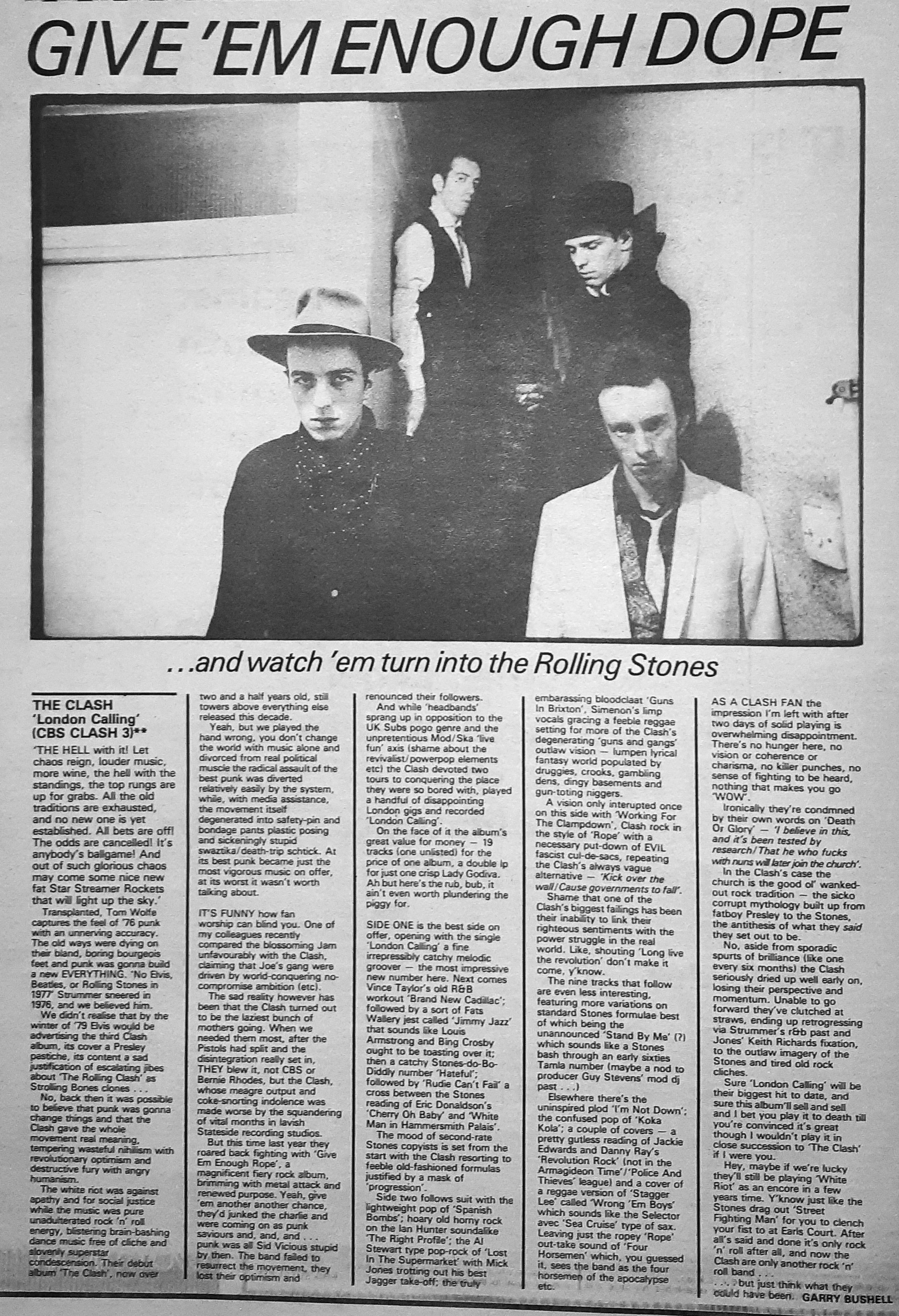
Garry Bushell - The Clash - London Calling - Sounds - December 15 1979


Resuming the series of reviews in which a critic is wrong-footed in real-time, with Garry Bushell giving a measly two-stars to the record that Rolling Stone would later anoint as Best Rock Album of the Eighties (even though technically it came out in the 1970s, at least in the band's native land, and at the very end of the decade, the last weeks of '79).

But, thinking about it, I don't even like London Calling. And all the reasons why Rolling Stone would rate it so high are exactly the reasons why Gazza finds it so boring - the relapse into Presley-Stones-etc rock's rich tapestry-ism. 

And within five years Strummer himself would be in resounding agreement with Gazza and would attempt to restage The Clash debut with Cut the Crap. 

Yes, despite various attempts over the years, I've never clicked with London Calling, apart from the title track single, and "Lost In the Supermarket," which I find affecting. 

The rest bypasses me....  it's like the Clash submitting belated candidacy to be part of the Last Waltz line-up....   a truce between New Wave and Old Wave.  (Getting Guy Stevens to produce - the man who more or less created Mott the Hoople - is totally the Old Wave into New Wave truce move).

I prefer Sandinista...  on points....  but also because they sound confused and dispirited...

The spiritedness of the Clash is one of the things I find least appealing about them - probably why I never clicked with the debut either. 

(That's why I'm endeared towards "Lost in the Supermarket" - a Strummer song, and Strummer sentiment-admission of frailty - even though it's Jones who sings it, with trademark wetness).

Saturday, October 26, 2024

Rose Rouse - Kate Bush - The Dreaming - Sounds - November 1982

Continuing the series of critics getting it wrong in real-time, not divining the significance of a release or artist... here's Rose Rouse in Sounds underestimating Kate Bush's The Dreaming.

Still, in mitigation, it would have to be said that Rose was not alone here - in fact Bush had almost zero critical support from the thinking person's press at this time - that all came with The Hounds of Love

And as slag-offs go, it's well argued and even somewhat convincing. 


Saturday, October 12, 2024

Lester Bangs on Miles Davis (originally published Phonograph Record, June 1976; republished NME, April 30 1983)

Continuing the series of critics missing the significance of a record on its initial release - here is Lester Bangs in 1976 with what is ostensibly a review of Agharta but is really a panoramic takedown of Miles Davis after In A Silent Way. It's included here mainly for its utterly wrongheaded take on On The Corner and similarly dismissive reaction to Get Up With It. 

Originally published in Phonograph Record in June 1976, the piece was reprinted in NME in 1983 as a tribute following Bangs's death and that's what is reproduced here (to read it in full you might need to download the images - but there is a portion of it in text form below). 

By the end of the 1970s Bangs completely changed his tune and decided that On The Corner was genius and in some piece or other (corralled in Psychotic Reactions) declared that he would stake his writing life on Get Up With It and Metal Box. 

Nowadays you will get lists that place On the Corner as #1 Miles album.


".... But here I sit, nearly three years later, and this man and his music refuse to ease their stranglehold on my tastes, more, my emotions. I am obsessed with him because he once released Sketches of Spain, which contains an adagio passage in Rodrigo’s ‘Concierto De Aranjuen’ which may hold more distilled sorrow than any other single solo by anyone I have ever heard; I am obsessed with him because Kind of Blue, like Birth of the Cool a decade previous, defined an era and produced some of the most beautiful, spacious, expansively inspired music it was to know; I’m obsessed because In a Silent Way came close to changing my life, reinstalling a respect for the truly spiritual aspects of music when I was otherwise intent on wallowing in grits and metal; I’m obsessed, simply because he is Miles, one of the greatest musicians who ever lived, and when a giant gets cancer of the soul you have to weep or at least ask for a medical inquiry.

Which is why I have been studying Miles’ work for the past year or so, trying to figure out where (if?) he went wrong. Think about the fact that this guy has been making “jazz” records since the late Forties, and that many of them, way more than any single musician’s share, have become (to borrow the title of one) milestones. The man has defined at least three eras in American music – can Dylan say the same? Never mind that when In a Silent Way came out it had the same effect as Charlie Parker’s renaissance and influence on his followers – i.e., it ruined a whole generation of musicians who were so swept by its brilliant departure that they could do nothing but slavishly imitate so every goddamn album you heard dribbled the same watered-down-kitsch-copy of Miles’ electric cathedral – it remains that now, seven years later. In a Silent Way not only has not dated but stands with Sketches of Spain and a few other Miles albums as one of the sonic monuments of our time. And that’s neither hype nor hyperbole.

But since then, the years, private problems, celebrityhood, hipper-than-thous – something, whatever, has taken its toll. On the Corner was garbage. So was, with the possible exception of one bit I have been told about but am unable to find in its four unbounded 30-minute sides, Miles Davis in Concert, Big Fun and Get Up with It were largely left-overs, with predictably erratic results. The former’s “Go Ahead John” was a cooker, but too much of the rest was something never previously expected of Miles, simple ideas repeated for whole sides, up to a half hour each, in an electronicized receptiveness and distortion-for-its-own-sake that may have been intended as hypnotic but ended up merely static. What was perhaps even more disturbing was that once you got past the predictability and disappointment and analyzed the actual content of the music, it took Miles past his traditional (and traditionally heart-wrenching) penchant for sustained moods of deep sadness into a new area redolent more of a by turns muzzy and metallic unhappiness. He should have called one of these albums Kind of Grim. And mere unhappiness, elaborated at whatever electro-technocratic prolixity, is not nearly the same as anguish.

Much of Miles’ finest music, from Blue Moods to “Prayer” on Porgy and Bess to Sketches to My Funny Valentine, has been about inner pain translated into a deep mourning poetry so intense and distilled that there have been times when I (and others have reported similar reactions) have been almost literally unable to take it. I have always been offended when people ask me to take off any jazz record because they find it “depressing,” but secretly I always knew what they meant. Because there were times when I found Miles’ anguish not purgative but depressing, when I had to yank Jack Johnson out of the 8-track deck because I could not drive to the laundromat with such a weight on my heart; but I also knew the reason why I (and, if I may be presumptuous, the nebulous anti-jazz people I just mentioned) was depressed: because at that moment there was something wrong with me, of a severity that could reach by degrees from my consciousness to my heart to my soul; because I was sweeping some deep latent anguish under the emotional carpet, or not confronting myself on some primal level – and Miles cut through to that level. His music was that powerful: it exposed me to myself, to my own falsity, to my own cowardice in the face of dread of staved-off pain. Because make no mistake, Miles understands pain – and he will pry it out of your soul’s very core when he hits his supreme note and you happen, coincidentally, to be a bit of an open emotional wound at that moment yourself. It is this gift for open-heart surgery that makes him the supreme artist that he is. So, obviously, I am damned if I am going to shrug him off at this point. I am going to tear these fucking records apart and find out what the source of the cancer running through them is, praying for cure....."

He's not wrong about the soul-sickness in Miles's music of the 1970s... but for the life of me I can't see why he didn't recognise that this made this music compelling, a puzzle worth solving. 

^^^^^^^^^


Here as a chaser is Bangs getting it right in real time:  a rhapsody about In A Silent Way for Rolling Stone. 

Miles Davis
In A Silent Way
by Lester Bangs


This is the kind of album that gives you faith in the future of music. It is not rock and roll, but it’s nothing stereotyped as jazz either. All at once, it owes almost as much to the techniques developed by rock improvisors in the last four years as to Davis’ jazz background. It is part of a transcendental new music which flushes categories away and, while using musical devices from all styles and cultures, is defined mainly by its deep emotion and unaffected originality.

Miles has always gone his own way, a musician of strength and dignity who has never made the compromise (so poisonous to jazz now) with “pop” fads. It is a testimony to his authenticity that he has never worried about setting styles either, but continued his deeply felt experiment for two decades now. Albums like Miles Ahead, Kind of Blue and Sketches of Spain simply do not get old, and contain some of the most moving experiences that any music has to offer. In his new album, the best he has made in some time, he turns to “space music” and a reverent, timeless realm of pure song, the kind of music which comes along ever so often and stops us momentarily, making us think that this perhaps is the core around which all of our wayward musical highways have revolved, the primal yet futuristic and totally uncontrived sound which gives the deepest, most lasting sustenance to our souls, the living contemporary definition of great art.

The songs are long jams with a minimum of preplanned structure. That they are so cohesive and sustained is a testament to the experience and sensitivity of the musicians involved. Miles’ lines are like shots of distilled passion, the kind of evocative, liberating riffs that decades of strivers build their styles on. Aside from Charles Mingus, there is no other musician alive today who communicates such a yearning, controlled intensity, the transformation of life’s inchoate passions and tensions into aural adventures that find a permanent place in your consciousness and influence your basic definitions of music. And his sidemen also rise to the occasion, most of them playing better than I have ever heard them before. Certainly Herbie Hancock (piano), Wayne Shorter (tenor sax), and Joe Zawinul (organ) have never seemed so transported. The miracle of jazz is that a great leader can bring merely competent musicians to incredible heights of inspiration —; Mingus has always been famous for this, and Miles has increasingly proven himself a master of this incredibly delicate art.

The first side is taken up by a long jam called “Shhh/Peaceful.” Tony Williams’ cymbal-and-brush work and the subtle arabesques of Zawinul’s organ set a space trip, a mood of suspended time and infinite interior vistas. But when Miles enters, the humanity and tenderness of his trumpet’s soft cries are enough to bring you tears. I’ve heard that when he was making this album, Miles had been listening to Jimi Hendrix and Sly and the Family Stone, but the feeling here is closer to something like “2000 Light Years From Home” by the Stones. It is space music, but with an overwhelmingly human component that makes it much more moving and enduring than most of its rock counterparts.

Side two opens and closes with the best song on the album, a timeless trumpet prayer called “In a Silent Way.” There has always been something eternal and pure in Miles’ music, and this piece captures that quality as well as anything he’s ever recorded. If, as I believe, Miles is an artist for the ages, then this piece will be among those that stand through those vast tracks of time to remind future generations of the oneness of human experience.

Between the two takes of “Silent Way” lies “It’s About That Time,” a terse, restrained space jam somewhat reminiscent of the one on the first side but a bit sharper, allowing more of Miles’ fierce blues ethos to burn through. This is the one that might be connected to Miles’ interest in Hendrix and Sly.

They say that jazz has become menopausal, and there is much truth in the statement. Rock too seems to have suffered under a numbing plethora of standardized Sounds. But I believe there is a new music in the air, a total art which knows no boundaries or categories, a new school run by geniuses indifferent to fashion. And I also believe that the ineluctable power and honesty of their music shall prevail. Miles Davis is one of those geniuses.


^^^^^^^^^

Not one of his great reviews - often in praise mode he over-relies on these windy vague terms, a rather standard lexicon of humanist-literary approbation. “Timeless”, “heights of inspiration”, “the oneness of human experience”. Almost a sense of being intimidated by the subject.

^^^^^^^^^^^

And here's me with the benefit of hindsight - but well before it became a fashionable opinion - bigging up OTC. August 17 1991, Melody Maker


Some windy, lofty lingo in there - and below too.

From a few years earlier - September 2 1989 - a paean to Silent Way.