Showing posts with label NME 1980. Show all posts

Tuesday, May 26, 2026

proto-Titanic and post-Titanic

I've posted here before about Mick Farren's famous "The Titanic Sails At Dawn" polemic. Appearing in the NME's June 19 1976 issue, the piece is legendarily claimed to have played a precipitative role in the punk uprising. It identified a malaise in rock: the loss of its connection to "the streets" and "the kids" that traverse them;  the recline and fall of a rebel sound into mere showbiz.  And in the process it birthed a mini-genre of explicitly or implicitly Titanic-themed jeremiads, which cropped up in the pages of the NME over the next decade (as well as the pages of zines populated by NME-wannabes).

I've also noted here that six months earlier Mick Farren had written a very similar - and to my mind, sharper - argument in the first NME issue of 1976.  A piece that no one seems to remember, and for whatever reason, it didn't seem to have any precipitative effect.  Timing is everything. 

Talking about timing... Well, here's a funny thing: turns out Mick Farren wrote yet another similar piece almost a year before the first of those 1976 pieces. The complaint is the same: the Seventies so far is a wash-out and rock's new superstar aristocracy - aka the Uncle Toms of Teendom -  have "taken Rock off the streets and into the penthouse". 


And here's another funny thing - four years after "The Titanic Sails At Dawn", Farren rocks up yet again in the page of NME with a polemic about the music's aesthetic bankruptcy and directionlessness.


I suppose four handwringing thinkpieces across five or six years isn't that excessive.

At Monitor, I must have written two or three with that vibe in just two years / six issues.

David Stubbs wrote a piece on that theme in virtually every issue of Monitor -  hilariously vivid evocations of impending entropy.

And then at the end of '86 we co-wrote a rather gloomy overview for Melody Maker (the editor complained it was a bummer way to wrap up the year).  Not one of our most coherent efforts, but maybe I should dredge it up as a period curio.


^^^^^^^^^^^^^^^^

Not forgetting Mick Farren's entire book on this approximate subject.... from a few years prior to the 1975 piece "The Kids Are Not Necessarily Alright".   With the word "Kids" in the title. 


At that point - most likely writing the book in 1971 -  Farren still retained some optimism about the radical potential of rock and youth culture. The tone of Watch Out Kids is defiant - the gathering decadence can be turned around. 

The story of "how Elvis gave birth to the Angry Brigade" promises the jacket copy.


^^^^^^^^^^^^^^^^^

This is a genre of rock essay - the dispirited measuring of Rock's vital signs. 

A classic example is this piece by Greil Marcus.

Some of Lester Bangs's most famous pieces are in that mode, albeit always pointing to green shoots of vitalizing vulgarity that defy the overall atrophy. 

No surprises here, but I personally love the "The Death of ________" essay. 

Every art form has its examples.  E.g. "The Literature of Exhaustion". 


Wednesday, January 15, 2025

Nick Kent - The Cure - Seventeen Seconds - NME - April 26 1980

 Continuing our series on critics wrong-footed in real time, here's Nick Kent immune to The Cure's Seventeen Seconds


To be honest, this is not so much a "wrong" opinion - certainly not an opinion shown up by the passage of time, by History having come to a different view - so much as an opinion that differs from my own opinion! 

The aspects that Kent finds frustrating - the vagueness, the tentativeness, the foggy pensiveness,  a sense of things being withheld, emotional indeterminacy - are exactly the  qualities of the album I find intriguing and attractive.

I feel like it's a record that could only come out of English suburbia...   (Crawley is almost exactly the same distance from London as my hometown Berkhamsted is, just on the other side of the metropolis).

Yet having said that, the atmosphere sometimes puts me in mind of Pessoa's The Book of Disquiet

Because of my life experience it inevitably conjures Home Counties memories of  listlessness-as-bliss... mystical mundanity...

A Thursday afternoon in an unseasonably damp, overcast August. Poor visibility, light drizzle muffling the sense of distance. 

The mood reminds me of this scene in Jonathan Coe's The Rotters Club - an ecstasy of ennui enfolds the main character, an introspective teenage schoolboy... Time stands still.


Interesting that Kent detects an Eno-ish aspect here and there, because the record sometimes reminds me too of the washed-out ambience and washed-up characters in certain songs on Another Green World and Before and After Science

I'd always thought The Cure on Seventeen Seconds were trying to pick up on the ethereal drift of side 2 of Closer - but checking the dates I see that they were making this record at around about the same time as Joy Division were working on their own second album. 

Seventeen Seconds is all about that translucent sound.... the new toys they've got for the guitar... the subtle tricks that Mike Hedges came up with (the triggered drum whooosh in "A Forest").  

Yes, for me, Seventeen Seconds is the only Cure album that I would actively put on. 

Like with New Order, the Cure's best album is obviously going to be a best-of, a singles compilation. 

Seventeen Seconds, though, is a consummate album-album... it corresponds to Trevor Horn's dictum that a great album consists of ten to twelve songs that all sound similar, just different enough- chips off the same lustrous block, as I said of Juju and a line probably recycled about various other albums over the years. (Trev's own example was Hats by The Blue Nile). It's a mood to sink into, a mood sustained and inflected. 

Having said it's an album album, Seventeen Seconds does also contain The Cure's most singular single: "A Forest", six minutes of gauche glory that sounds like nothing else in music before or since,

Kent closes his Seventeen Seconds review with a statement of being disappointed this time round but  highly intrigued to know what their next move will be -  I wonder if he did carry on following the Cure's arc and what he made of the subsequent albums, career triumphs, ever-growing megacult popularity?  Did he bother to listen to this year's "towering, best album since ____" ? (I didn't). 


Sunday, March 12, 2023

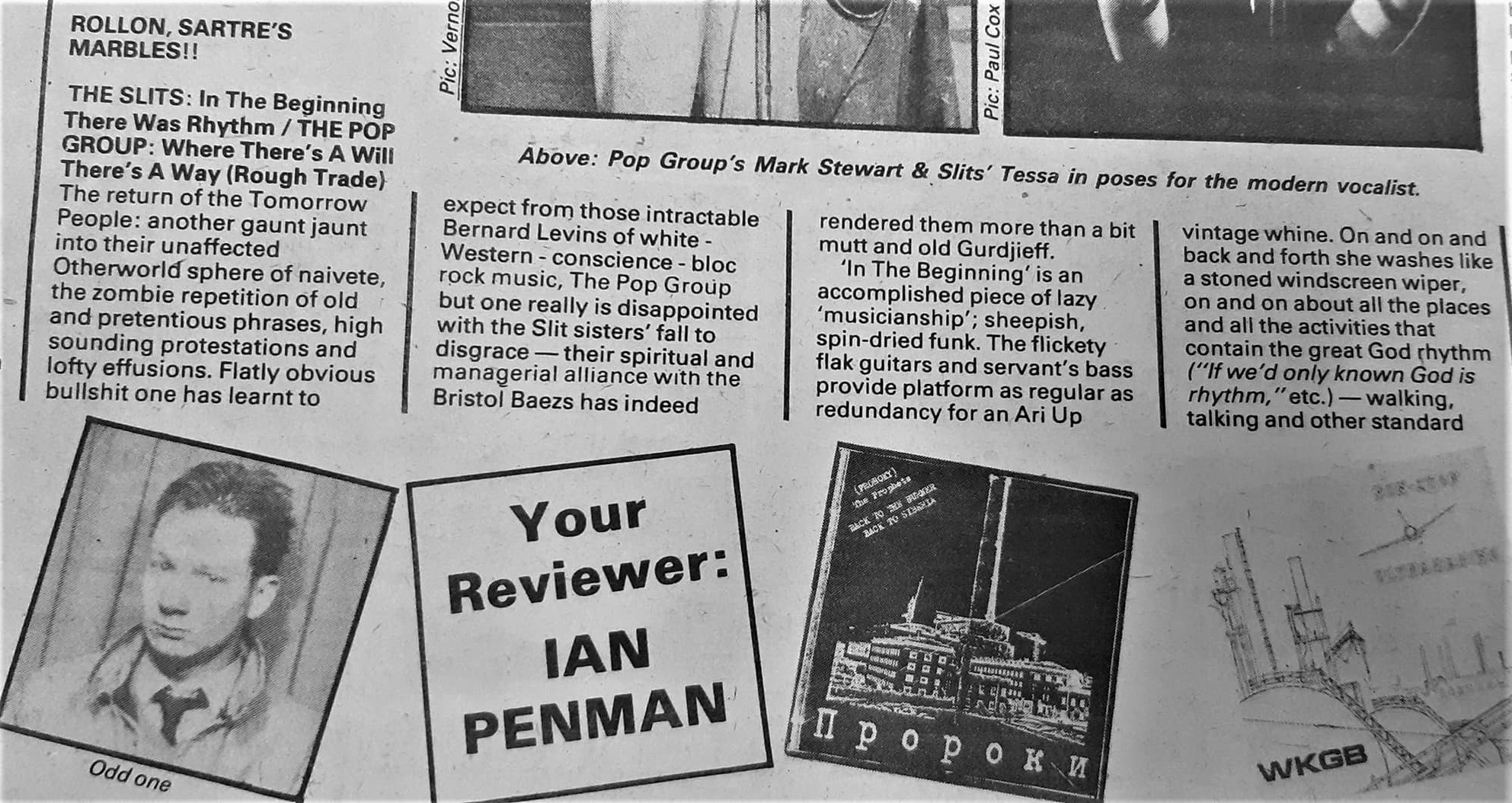
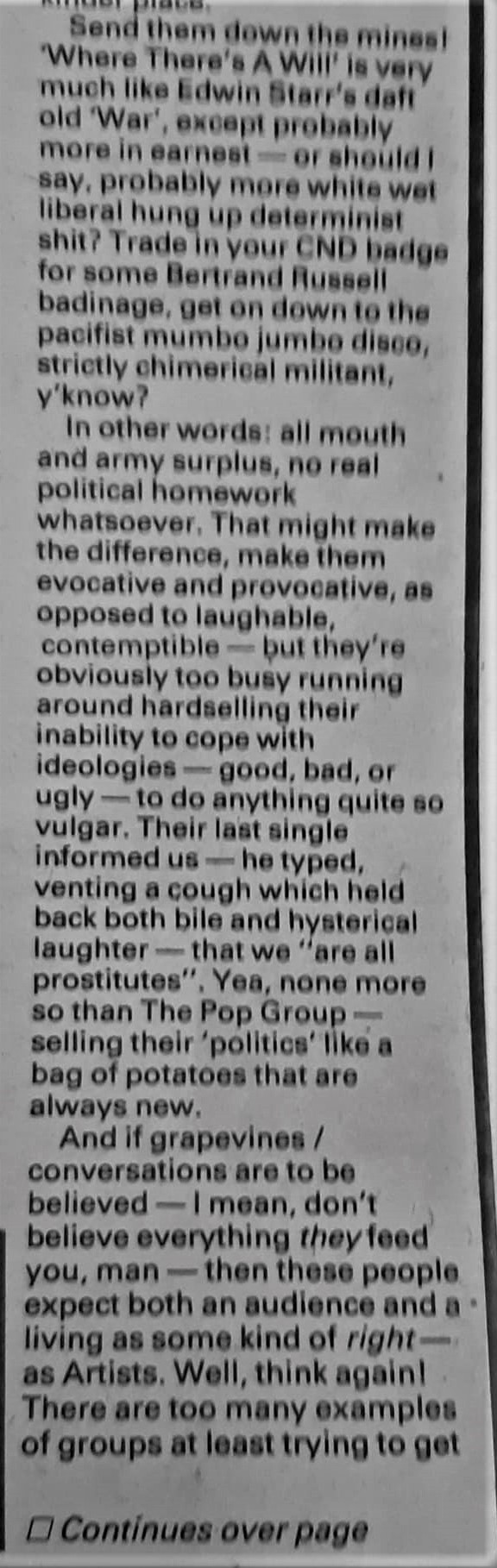
Ian Penman versus The Pop Group + The Slits (x 2) - New Musical Express - June 1980


A few weeks later the Slits / Pop Group / Y-Tribe invited I Punman to submit to the tribunal of a polylogue, a tense and not hugely profitable exchange of views


(via Matthew Worley + Tom Vague + Nothingelseon )